
Top 10 Most Affordable States for Groceries in Malaysia (2026)
We priced the same 20 everyday groceries in every state using 265,791 KPDN PriceCatcher records from September 2026, then weighed the basket against each state's food inflation and median household income. Selangor comes first on the combined score, Perak has the cheapest basket outright, and Sabah and Putrajaya are the dearest places to fill a trolley.
This is an Editorial ranking. Positions come from our own weighted score (basket price 40, food inflation 30, basket as a share of household income 30) computed from raw KPDN PriceCatcher, DOSM CPI and DOSM HIES data published on data.gov.my. Prices are shelf prices recorded by KPDN officers in September 2026; promotions and member-card prices are not captured, and prices in individual towns differ.

Quick answer
Selangor is the most affordable state for groceries in Malaysia in 2026, scoring 68.6 out of 100 in Malaysia's Top Ten's analysis of KPDN PriceCatcher prices for September 2026, DOSM state food inflation and DOSM household income. Its 20-item basket cost RM219.92, just 2.05% of the state's median monthly household income of RM10,726. Perak (64.2) has the cheapest basket in the country at RM213.12 but a far lower median income, and Pulau Pinang (61.8), Kedah (57.3) and Johor (52.7) complete the top five. Putrajaya, Sabah and Kuala Lumpur have the most expensive baskets, at RM230 or more.
- Perak has the cheapest grocery basket in Malaysia at RM213.12, RM8.37 below the national median basket of RM221.49, with the country's lowest prices for chicken (RM8.99/kg), Buruh cooking oil (RM29.92), Milo (RM19.49) and Maggi curry noodles (RM4.90).
- Selangor wins on affordability rather than price: its basket is only the sixth-cheapest of 15, but at 2.05% of a RM10,726 median monthly income it takes the smallest share of household budgets in the country.
- Kelantan is the only state where food prices fell over the past year (-0.52% average, -0.3% in September 2026), yet the same basket consumes 5.49% of its RM4,083 median income, the highest burden in Malaysia, so it finishes ninth.
- Sabah ranks last of 15. Its basket (RM230.79) is the second-dearest, driven by chicken at RM12.89/kg against RM8.99 in Perak, eggs at RM16.50 and Top detergent at RM24.99; Putrajaya has the single most expensive basket at RM231.14.
- Johor's basket is cheap (RM218.90, with the lowest egg, potato and sardine prices) but its food inflation of 3.6% in September 2026 was the highest in the country, leaving it just 2.5 of a possible 30 inflation points.
How this ranking was decided
This is an Editorial ranking of all 16 states and federal territories. We computed one fixed 20-item grocery basket per state from 265,791 raw KPDN PriceCatcher records (September 2026, downloaded 22 October 2026), covering 2,140 supermarkets, mini markets, sundry shops and wet markets. Three dimensions are scored with declared weights: basket price (40%), average food and beverage inflation over the 12 months to September 2026 (30%, DOSM state CPI) and the basket as a share of the state's 2024 median household income (30%, DOSM HIES). Each dimension is scaled so the best state earns the full weight and the worst earns zero. The basket, weights and eligibility rule were fixed before any score was computed; 15 states qualified and Labuan was excluded for having too few price reports.
Full details in How this ranking was produced below.
The ranking at a glance
| # | Name | Score | Best for | Main advantage | Main limitation |
|---|---|---|---|---|---|
| 1 | Selangor | 68.6/100 | Households with Klang Valley incomes who shop at hypermarkets and neighbourhood supermarkets rather than premium grocers. | Basket is just 2.05% of median monthly household income | Basket itself only sixth-cheapest at RM219.92 |
| 2 | Perak | 64.2/100 | Shoppers who care about shelf prices above all, and retirees or remote workers on a fixed income. | Cheapest basket in Malaysia, RM213.12 | Median household income of RM4,687, second-lowest in the country |
| 3 | Pulau Pinang | 61.8/100 | Households that want big-city incomes with prices below the Klang Valley's. | Balanced: third-cheapest basket and third-highest state income | No dimension where it leads; cabbage dearest in the peninsula |
| 4 | Kedah | 57.3/100 | Families buying rice in bulk and shoppers in the northern states. | Second-cheapest basket and cheapest 10kg rice (RM33.70) | Basket takes 4.40% of a RM4,895 median income |
| 5 | Johor | 52.7/100 | Southern households with above-average incomes who shop away from the Causeway's tourist pricing. | Cheapest eggs, potatoes and sardines in Malaysia | Highest food inflation in the country, 3.6% in September 2026 |
| 6 | Terengganu | 51.8/100 | East-coast households, where prices are stable and incomes are the highest in the region. | Food inflation of 0.6% in September 2026, joint third-lowest | Basket above the national median at RM224.22 |
| 7 | Perlis | 47.5/100 | Northern households who value stable prices over the lowest shelf price. | Food inflation of 0.3% in September 2026, lowest positive rate | Only 37 reporting premises; fish price filled with the national median |
| 8 | Melaka | 47.4/100 | Households that buy a lot of fresh chicken and vegetables. | Second-cheapest chicken in the peninsula, RM9.09/kg | Food inflation of 2.3% in September 2026, above the national 1.8% |
| 9 | Kelantan | 45.9/100 | Households watching price trends: shelves are not cheap, but they are not getting dearer. | Only state where food prices fell over the past year (-0.3% in Sept 2026) | Basket takes 5.49% of a RM4,083 median income, the highest share in Malaysia |
| 10 | W.P. Putrajaya | 42/100 | High-income households for whom a RM10 difference in a monthly basket matters less than convenience. | Basket only 2.15% of a RM10,769 median income | Most expensive basket in Malaysia, RM231.14 |
Where in Malaysia does a trolley of basic groceries hurt the least? The usual answer, "the east coast is cheap, the Klang Valley is expensive", turns out to be only half right. DOSM's September 2026 Consumer Price Index put food and beverage inflation at 1.8% nationally, with every state recording an increase except Kelantan (DOSM). But inflation measures change, not level. To compare levels we used the raw records behind KPDN's PriceCatcher app, in which price officers log shelf prices at thousands of shops every month (The Vibes), and priced one fixed basket of 20 everyday items in every state, the same basket we used for our ranking of the cheapest Klang Valley supermarkets.
Price alone does not decide affordability, so we scored each state on three things: what the basket costs, how fast food prices have been rising over the past year, and how big a bite the basket takes out of the typical household's monthly income. The result splits the country into three groups. Perak, Kedah and Johor have genuinely cheap shelves. Selangor and Pulau Pinang pay a little more but earn much more. Sabah, Sarawak, Putrajaya and Kuala Lumpur pay the most, for very different reasons. For how we build Editorial rankings in general, see our ranking methodology; for more on eating and shopping in Malaysia, browse the Food & Dining hub.
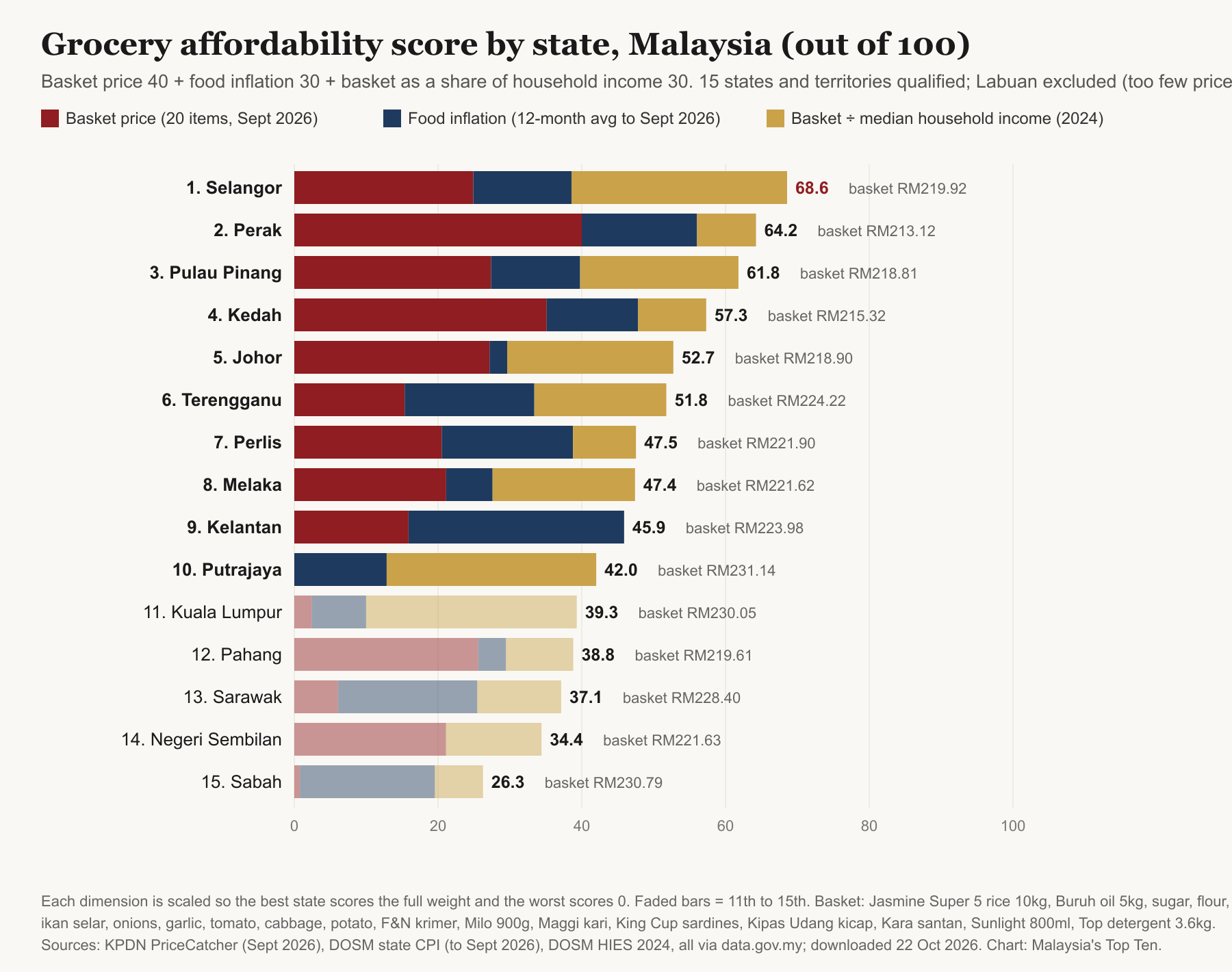
How the score works
| Dimension | Weight | How points are awarded |
|---|---|---|
| Basket price | 40 | Cost of 20 fixed items (10kg Jasmine Super 5 rice, 5kg Buruh oil, sugar, flour, 30 eggs, chicken, ikan selar, onions, garlic, tomatoes, cabbage, potatoes, F&N creamer, Milo, Maggi curry, King Cup sardines, Kipas Udang kicap, Kara santan, Sunlight, Top detergent). State price per item = median of the medians of every reporting retail premise in September 2026. Cheapest state scores 40, dearest 0, others in proportion. |
| Food inflation | 30 | Average year-on-year change in the DOSM Food & Beverages CPI for the state over the 12 months to September 2026. Lowest scores 30, highest 0. |
| Income burden | 30 | Basket cost divided by the state's median gross monthly household income in DOSM's HIES 2024. Smallest share scores 30, largest 0. |
A state needed prices for at least 18 of the 20 items, each from five or more premises. Sabah and Sarawak lacked the imported Jasmine Super 5 rice (they are supplied through a separate, subsidised imported-rice channel; Sinar Harian) and Perlis lacked ikan selar, so those single items were filled with the national median. Labuan reported only 15 items and was excluded.
Cheap shelves versus deep pockets
Perak's RM213.12 basket is the cheapest in Malaysia by RM2.20 over Kedah and RM8.37 under the national median of RM221.49. It has the lowest price in the country for standard chicken (RM8.99 a kilo), Buruh cooking oil (RM29.92), Milo (RM19.49), Maggi curry noodles (RM4.90) and Kipas Udang soy sauce (RM6.25). Kedah, the rice bowl that grows more than 40% of Malaysia's local white rice (New Straits Times), has the cheapest 10kg bag of rice at RM33.70 and the cheapest Sunlight at RM5.99. Johor has the lowest prices for eggs (RM15.29 for 30), potatoes (RM2.99) and King Cup sardines (RM8.89).
Yet Selangor, whose basket is only sixth-cheapest at RM219.92, takes first place. Its median household income of RM10,726 a month (DOSM HIES 2024) means the basket costs 2.05% of a typical month's income, the smallest share in the country and less than half the 4.55% a Perak household gives up. Selangor's median income rose from RM8,210 to RM10,726 over the state's first development plan (Newswav), and that income effect outweighs a middling basket. The same logic lifts Pulau Pinang (RM7,386) to third and keeps Kuala Lumpur and Putrajaya, with the dearest baskets in the country, within reach of the top ten. Groceries are only part of a household budget, of course: DOSM's 2024 Cost of Living Index, which also counts housing and transport, ranks Putrajaya, Kuala Lumpur and Selangor as the three most expensive places to live (The Vibes). Our ranking of Malaysia's richest districts shows where those high incomes sit.
Inflation changes the order
Kelantan is the only state where food was cheaper in September 2026 than a year earlier: its food and beverage CPI averaged -0.52% over the past 12 months and was -0.3% in September, after readings of -0.7% in February and March (Berita Harian). That earns it the full 30 inflation points, but its basket is only the tenth-cheapest and its median income of RM4,083 is the lowest in Malaysia, so groceries take 5.49% of income and it finishes ninth. Johor shows the opposite pattern: a cheap basket undone by the country's highest food inflation, 3.6% in September and 2.57% on average, as Singapore spending pushes up prices near the Causeway. The Singapore Business Federation expects Singaporeans to spend an extra S$1.05 billion (RM3.37 billion) a year in Johor once the RTS Link opens in January 2027, with groceries the largest category, and the Johor Bumiputera Consumer Association has warned that local shoppers will feel it (The Star). Negeri Sembilan, with the highest 12-month average food inflation (2.84%), drops to 14th despite an average basket.
The Borneo gap
Sabah's basket of RM230.79 is RM17.67 dearer than Perak's, and the gap is concentrated in protein and packaged goods: chicken RM12.89 a kilo, eggs RM16.50, cabbage RM7.50, Top detergent RM24.99 and Milo RM21.80 are all the highest or near-highest in the country. Sabah's agriculture minister attributes the chicken and egg premium to feed, 98% of which is imported, with corn alone making up 60% to 70% of production cost (Daily Express), and a Sabah advocacy group estimates that transport costs across the supply chain rose 8% to 20% after the subsidised diesel control system was introduced (Daily Express). The one item where Sabah beats everyone is fresh fish: ikan selar at RM12.00 a kilo against RM21.99 in Putrajaya. Sarawak (RM228.40) has the dearest tomatoes (RM12.00) and eggs (RM16.90) but, like Sabah, enjoys low food inflation of under 1%. Families comparing states for more than the weekly shop can read our ranking of the best districts to raise a family.
The full ranking
Selangor
Score: 68.6Malaysia's most populous state and its economic centre, wrapped around Kuala Lumpur; 136 Selangor supermarkets, mini markets and sundry shops reported basket prices in September 2026.
Why it was selected
Scores 68.6/100, first of 15. Selangor's basket of RM219.92 is only the sixth-cheapest (KPDN PriceCatcher via data.gov.my), but its median household income of RM10,726 a month is the highest of any state (DOSM HIES 2024), so the basket takes 2.05% of a typical month's income, the smallest share in Malaysia and worth the full 30 income points. Food inflation averaged 1.31% over the past year, below the national 1.49%. Buruh cooking oil (RM29.99) and Kara santan (RM3.75) are among the cheapest in the country; chicken (RM9.39/kg) sits at the national median and Milo (RM19.95) just below it. The state's median income rose from RM8,210 to RM10,726 over its first development plan (Newswav).
Best for
Households with Klang Valley incomes who shop at hypermarkets and neighbourhood supermarkets rather than premium grocers.
Advantages
- Basket is just 2.05% of median monthly household income
Limitations
- Basket itself only sixth-cheapest at RM219.92
- Location:
- Selangor
- Verified:
- 22 Oct 2026
- Affordability score:
- 68.6/100
- 20-item basket (Sept 2026):
- RM219.92
- Basket as share of median income:
- 2.05% (RM10,726)
Sources: KPDN PriceCatcher — data.gov.my, DOSM household income by state — data.gov.my, Newswav — Selangor median income under RS-1 and RS-2
Perak
Score: 64.2The large west-coast state centred on Ipoh, with Malaysia's second-largest land area in the peninsula; 192 Perak retail premises reported basket prices in September 2026.
Why it was selected
Scores 64.2/100. Perak has the cheapest grocery basket in Malaysia at RM213.12, RM8.37 below the national median and worth the full 40 price points (KPDN PriceCatcher via data.gov.my). It has the country's lowest prices for standard chicken (RM8.99/kg), Buruh cooking oil (RM29.92 for 5kg), Milo (RM19.49), Maggi curry noodles (RM4.90) and Kipas Udang soy sauce (RM6.25), and its Top detergent (RM19.99) and Sunlight (RM6.20) are near the bottom too. Food inflation averaged just 1.04%. What holds it to second is income: the median household earns RM4,687 a month, the second-lowest in the country after Kelantan, and recorded the slowest growth of any state between 2022 and 2024 at 2.1% (The Vibes, citing HIES 2024), so the basket takes 4.55% of income.
Best for
Shoppers who care about shelf prices above all, and retirees or remote workers on a fixed income.
Advantages
- Cheapest basket in Malaysia, RM213.12
Limitations
- Median household income of RM4,687, second-lowest in the country
- Location:
- Perak
- Verified:
- 22 Oct 2026
- Affordability score:
- 64.2/100
- 20-item basket (Sept 2026):
- RM213.12 (cheapest)
- Basket as share of median income:
- 4.55% (RM4,687)
Sources: KPDN PriceCatcher — data.gov.my, The Vibes — HIES 2024: Perak slowest income growth
Pulau Pinang
Score: 61.8The island-and-mainland state around George Town, Malaysia's electronics manufacturing hub; 147 Penang retail premises reported basket prices in September 2026.
Why it was selected
Scores 61.8/100. Penang is the most balanced state in the ranking, with no dimension scoring below 12 points. Its basket of RM218.81 is third-cheapest (KPDN PriceCatcher via data.gov.my), helped by Jasmine Super 5 rice at RM33.99 and Milo at RM19.50, although Beijing cabbage at RM4.99/kg is the dearest in the peninsula. Its median household income of RM7,386 is the third-highest of any state (DOSM HIES 2024), so the basket takes 2.96% of income, and food inflation averaged 1.45%, close to the national 1.49%.
Best for
Households that want big-city incomes with prices below the Klang Valley's.
Advantages
- Balanced: third-cheapest basket and third-highest state income
Limitations
- No dimension where it leads; cabbage dearest in the peninsula
- Location:
- Pulau Pinang
- Verified:
- 22 Oct 2026
- Affordability score:
- 61.8/100
- 20-item basket (Sept 2026):
- RM218.81
- Basket as share of median income:
- 2.96% (RM7,386)
Sources: KPDN PriceCatcher — data.gov.my, DOSM household income by state — data.gov.my
Kedah
Score: 57.3The northern rice-bowl state around Alor Setar and Sungai Petani, home to the MADA irrigation scheme; 122 Kedah retail premises reported basket prices in September 2026.
Why it was selected
Scores 57.3/100. Kedah's basket of RM215.32 is the second-cheapest in Malaysia, only RM2.20 behind Perak (KPDN PriceCatcher via data.gov.my). It has the cheapest 10kg bag of Jasmine Super 5 rice in the country at RM33.70, fitting for a state that grows more than 40% of Malaysia's local white rice (New Straits Times), plus the cheapest Sunlight (RM5.99) and Kipas Udang soy sauce at RM6.50, among the cheapest. Food inflation averaged 1.42%, though DOSM's September release listed Kedah's headline inflation of 2.2% among the eight states above the national rate. Its median income of RM4,895 (DOSM HIES 2024) means the basket takes 4.40% of income, which caps the score.
Best for
Families buying rice in bulk and shoppers in the northern states.
Advantages
- Second-cheapest basket and cheapest 10kg rice (RM33.70)
Limitations
- Basket takes 4.40% of a RM4,895 median income
- Location:
- Kedah
- Verified:
- 22 Oct 2026
- Affordability score:
- 57.3/100
- 20-item basket (Sept 2026):
- RM215.32
- Basket as share of median income:
- 4.40% (RM4,895)
Sources: KPDN PriceCatcher — data.gov.my, New Straits Times — Kedah's rice bowl
Johor
Score: 52.7Malaysia's southern gateway state, bordering Singapore, with the second-largest number of reporting premises in the country at 214, after Sarawak.
Why it was selected
Scores 52.7/100. Johor's basket of RM218.90 is fourth-cheapest and it has the lowest price in Malaysia for grade A eggs (RM15.29 for 30), imported potatoes (RM2.99/kg) and King Cup sardines (RM8.89), plus joint-cheapest tomatoes (RM7.49/kg) (KPDN PriceCatcher via data.gov.my). Its median income of RM7,712 is the second-highest of any state (DOSM HIES 2024), so the basket takes just 2.84% of income. The drag is inflation: Johor's food and beverage CPI rose 3.6% in September 2026, the highest in the country, and averaged 2.57% over the year, earning it only 2.5 of 30 inflation points. It already led food inflation at 2.8% in June (RinggitPlus), and the Singapore Business Federation expects Singaporeans to spend an extra RM3.37 billion a year in Johor once the RTS Link opens in January 2027, with groceries the largest category (The Star).
Best for
Southern households with above-average incomes who shop away from the Causeway's tourist pricing.
Advantages
- Cheapest eggs, potatoes and sardines in Malaysia
Limitations
- Highest food inflation in the country, 3.6% in September 2026
- Location:
- Johor
- Verified:
- 22 Oct 2026
- Affordability score:
- 52.7/100
- 20-item basket (Sept 2026):
- RM218.90
- Food inflation, Sept 2026 (12-month avg):
- 3.6% (2.57%)
Sources: KPDN PriceCatcher — data.gov.my, The Star — Grocery prices in JB may rise once RTS Link opens, RinggitPlus — June 2026 inflation, Johor highest food inflation
Terengganu
Score: 51.8The east-coast oil-and-gas state around Kuala Terengganu; 139 Terengganu retail premises reported basket prices in September 2026.
Why it was selected
Scores 51.8/100. Terengganu's basket of RM224.22 is above the national median and only eleventh-cheapest (KPDN PriceCatcher via data.gov.my): Maggi (RM5.22), Sunlight (RM7.00) and Top detergent (RM21.90) are all on the dear side. It earns its place on the other two dimensions. Food inflation averaged 0.82% over the year and was 0.6% in September 2026, joint third-lowest in the country after Kelantan and Perlis, and its median household income of RM6,627 (DOSM HIES 2024), the highest on the east coast, keeps the basket at 3.38% of income.
Best for
East-coast households, where prices are stable and incomes are the highest in the region.
Advantages
- Food inflation of 0.6% in September 2026, joint third-lowest
Limitations
- Basket above the national median at RM224.22
- Location:
- Terengganu
- Verified:
- 22 Oct 2026
- Affordability score:
- 51.8/100
- 20-item basket (Sept 2026):
- RM224.22
- Food inflation, Sept 2026 (12-month avg):
- 0.6% (0.82%)
Sources: KPDN PriceCatcher — data.gov.my, DOSM CPI inflation by state — data.gov.my
Perlis
Score: 47.5Malaysia's smallest state, on the Thai border north of Kedah; 37 Perlis retail premises reported basket prices in September 2026.
Why it was selected
Scores 47.5/100. Perlis has the lowest positive food inflation in Malaysia, 0.3% in September 2026, and a 12-month average of 0.79% (DOSM via data.gov.my). Its basket of RM221.90 sits at the national median: flour (RM2.98) and garlic (RM8.02/kg) are the cheapest in the peninsula, but rice (RM36.50) and tomatoes (RM9.90/kg) are among the dearest. Fewer than five premises reported ikan selar, so that item was filled with the national median of RM18.00. A median income of RM4,950 (DOSM HIES 2024) puts the basket at 4.48% of income.
Best for
Northern households who value stable prices over the lowest shelf price.
Advantages
- Food inflation of 0.3% in September 2026, lowest positive rate
Limitations
- Only 37 reporting premises; fish price filled with the national median
- Location:
- Perlis
- Verified:
- 22 Oct 2026
- Affordability score:
- 47.5/100
- 20-item basket (Sept 2026):
- RM221.90 (19 items priced)
- Food inflation, Sept 2026 (12-month avg):
- 0.3% (0.79%)
Sources: KPDN PriceCatcher — data.gov.my, DOSM CPI inflation by state — data.gov.my
Melaka
Score: 47.4The historic southern state around Melaka City; 53 Melaka retail premises reported basket prices in September 2026.
Why it was selected
Scores 47.4/100, a tenth of a point behind Perlis. Melaka's basket of RM221.62 is a whisker above Perlis (KPDN PriceCatcher via data.gov.my), with joint-cheapest tomatoes (RM7.49/kg) and the second-cheapest chicken in the peninsula (RM9.09/kg), offset by the peninsula's dearest Top detergent at RM23.24. Its median income of RM6,891 (DOSM HIES 2024) keeps the basket at 3.22% of income, but food inflation averaging 2.12% (2.3% in September) costs it points.
Best for
Households that buy a lot of fresh chicken and vegetables.
Advantages
- Second-cheapest chicken in the peninsula, RM9.09/kg
Limitations
- Food inflation of 2.3% in September 2026, above the national 1.8%
- Location:
- Melaka
- Verified:
- 22 Oct 2026
- Affordability score:
- 47.4/100
- 20-item basket (Sept 2026):
- RM221.62
- Basket as share of median income:
- 3.22% (RM6,891)
Sources: KPDN PriceCatcher — data.gov.my, DOSM household income by state — data.gov.my
Kelantan
Score: 45.9The north-eastern state around Kota Bharu, with 199 reporting retail premises, the third-most in the country.
Why it was selected
Scores 45.9/100. Kelantan is the only state in Malaysia where food got cheaper over the past year: its food and beverage CPI averaged -0.52% and was -0.3% in September 2026, after -0.7% in February and March (Berita Harian; DOSM's September release confirms it was the only state with a decrease). That is worth the full 30 inflation points. Everything else works against it. The basket costs RM223.98, tenth-cheapest, with rice at RM35.99, Milo at RM20.95 and sardines at RM9.65 all above the median (KPDN PriceCatcher via data.gov.my), and the median household income of RM4,083 is the lowest in Malaysia (DOSM HIES 2024), so the basket takes 5.49% of income, the heaviest burden in the country and zero points. DOSM's Cost of Living Index nonetheless rates Kelantan the cheapest state overall at 103.9 (The Vibes), because housing and transport are cheap even when groceries are not.
Best for
Households watching price trends: shelves are not cheap, but they are not getting dearer.
Advantages
- Only state where food prices fell over the past year (-0.3% in Sept 2026)
Limitations
- Basket takes 5.49% of a RM4,083 median income, the highest share in Malaysia
- Location:
- Kelantan
- Verified:
- 22 Oct 2026
- Affordability score:
- 45.9/100
- 20-item basket (Sept 2026):
- RM223.98
- Food inflation, Sept 2026 (12-month avg):
- -0.3% (-0.52%)
Sources: KPDN PriceCatcher — data.gov.my, Berita Harian — Kelantan food inflation negative, March 2026, The Vibes — Cost of Living Index 2024 by state
W.P. Putrajaya
Score: 42The federal administrative capital south of Kuala Lumpur, a planned city of civil servants; 28 Putrajaya retail premises reported basket prices in September 2026.
Why it was selected
Scores 42.0/100. Putrajaya has the most expensive grocery basket in Malaysia at RM231.14 (KPDN PriceCatcher via data.gov.my), with the dearest Jasmine Super 5 rice (RM37.99) and ikan selar (RM21.99/kg) in the country, plus Sunlight at RM7.50 and Maggi at RM5.35; only Top detergent (RM18.99, the cheapest anywhere) bucks the trend. It scores zero on price. It makes the top ten because its median household income of RM10,769 (DOSM HIES 2024) is the second-highest in Malaysia, so the basket takes 2.15% of income, and because food inflation averaged a moderate 1.40% over the year, although it jumped to 2.7% in September 2026. DOSM's 2024 Cost of Living Index also rates Putrajaya the most expensive place in Malaysia overall at 106.3 (The Vibes).
Best for
High-income households for whom a RM10 difference in a monthly basket matters less than convenience.
Advantages
- Basket only 2.15% of a RM10,769 median income
Limitations
- Most expensive basket in Malaysia, RM231.14
- Location:
- W.P. Putrajaya
- Verified:
- 22 Oct 2026
- Affordability score:
- 42.0/100
- 20-item basket (Sept 2026):
- RM231.14 (dearest)
- Basket as share of median income:
- 2.15% (RM10,769)
Sources: KPDN PriceCatcher — data.gov.my, The Vibes — Cost of Living Index 2024 by state
Frequently asked questions
Which state in Malaysia has the cheapest groceries in 2026?
Perak has the cheapest groceries in Malaysia in 2026, according to Malaysia's Top Ten's analysis of KPDN PriceCatcher prices for September 2026. A fixed basket of 20 everyday items (rice, cooking oil, eggs, chicken, fish, vegetables, Milo, sardines, detergent and more) cost RM213.12 in Perak, against RM215.32 in Kedah, RM218.81 in Pulau Pinang and a national median of RM221.49. Perak has the lowest prices in the country for standard chicken (RM8.99/kg), Buruh cooking oil (RM29.92 for 5kg), Milo (RM19.49 for 900g) and Maggi curry noodles (RM4.90).
Which is the most affordable state for groceries in Malaysia in 2026?
Selangor is the most affordable state for groceries in Malaysia in 2026, scoring 68.6 out of 100 in Malaysia's Top Ten's Editorial ranking, which weighs basket price (40%), 12-month food inflation (30%) and the basket as a share of median household income (30%). Selangor's basket of RM219.92 is only 2.05% of its RM10,726 median monthly household income (DOSM HIES 2024), the smallest share in the country. Perak (64.2), Pulau Pinang (61.8), Kedah (57.3) and Johor (52.7) follow.
Why is Selangor ranked above Perak if groceries are cheaper in Perak?
Perak's basket (RM213.12) is RM6.80 cheaper than Selangor's (RM219.92), but Selangor's median household income of RM10,726 is more than double Perak's RM4,687 (DOSM HIES 2024). The basket therefore takes 2.05% of a typical Selangor household's monthly income against 4.55% in Perak. In Malaysia's Top Ten's scoring, income burden carries 30 of 100 points, and that gap outweighs Perak's lead on price. Perak still scores 64.2, second overall, and is the clear choice for shoppers who care only about shelf prices.
Where are groceries most expensive in Malaysia?
Putrajaya had the most expensive grocery basket in Malaysia in September 2026 at RM231.14, followed by Sabah (RM230.79) and Kuala Lumpur (RM230.05), according to Malaysia's Top Ten's calculation from KPDN PriceCatcher data. Putrajaya has the dearest rice (RM37.99 for 10kg) and ikan selar (RM21.99/kg); Sabah has the dearest chicken (RM12.89/kg, against RM8.99 in Perak), cabbage (RM7.50/kg) and Top detergent (RM24.99). Sabah ranks last of 15 states on the combined affordability score, at 26.3.
Which Malaysian state has the lowest food inflation in 2026?
Kelantan has the lowest food inflation in Malaysia in 2026 and is the only state where food prices fell: its Food & Beverages CPI was -0.3% year on year in September 2026 and averaged -0.52% over the 12 months to September (DOSM via data.gov.my). Perlis (0.3% in September, 0.79% average), Terengganu and Sabah (0.6% each in September) were next lowest. Johor had the highest at 3.6% in September 2026, followed by Negeri Sembilan at 3.0%.
How much does a basic grocery basket cost in Malaysia in 2026?
A basket of 20 everyday groceries (10kg rice, 5kg cooking oil, 1kg sugar, 1kg flour, 30 eggs, 1kg chicken, 1kg ikan selar, five vegetables, F&N creamer, Milo, Maggi, sardines, soy sauce, coconut milk, dishwashing liquid and detergent) had a national median cost of RM221.49 in September 2026, according to Malaysia's Top Ten's calculation from KPDN PriceCatcher records across 2,140 retail premises. The cheapest state was Perak at RM213.12 and the dearest was Putrajaya at RM231.14, a gap of RM18.02 or 8.5%.
Is Sabah or Sarawak more expensive for groceries?
Sabah is slightly more expensive than Sarawak for everyday groceries: the same 20-item basket cost RM230.79 in Sabah and RM228.40 in Sarawak in September 2026, according to Malaysia's Top Ten's analysis of KPDN PriceCatcher data. Sabah is dearer for chicken (RM12.89 vs RM10.95/kg), cabbage and detergent, while Sarawak is dearer for tomatoes (RM12.00/kg) and eggs (RM16.90 for 30). Both states have low food inflation, under 1% on average over the past year, and both lack the imported Jasmine Super 5 rice sold in the peninsula, so that item was filled with the national median.
How this ranking was produced
- Question: In which Malaysian state are everyday groceries most affordable for a typical household?
- Type: Editorial ranking with declared weights: basket price 40, food inflation 30, basket as a share of median household income 30. Rules, weights and basket recorded on 22 October 2026 before any score was computed.
- Candidate pool: all 13 states and 3 federal territories.
- Basket data: KPDN PriceCatcher transactional records (dataset
pricecatcher, filepricecatcher_2026-09.csv, 1–29 September 2026) with the premise and item lookup tables, downloaded from storage.data.gov.my on 22 October 2026. Retail premises only: hypermarkets, supermarkets, mini markets, sundry shops, wet markets and convenience stores; wholesalers, restaurants and food courts excluded. 2,140 premises and 265,791 price records for the 20 basket items. - Basket calculation: (1) median of all September prices per premise per item; (2) state price per item = median of those premise medians, counted only where five or more premises in the state reported the item; (3) basket = sum of the 20 state prices. National median basket (sum of the national item medians) = RM221.49.
- Eligibility: at least 18 of 20 items priced. Missing items filled with the national item median and disclosed: Sabah and Sarawak (Jasmine Super 5 rice), Perlis (ikan selar). Labuan priced 15 items and was excluded.
- Food inflation: DOSM Monthly CPI Inflation by State (dataset
cpi_state_inflation), division 01 Food & Beverages, year-on-year rate averaged over October 2025 to September 2026 (12 months). The September 2026 figure is shown for context but the average is what is scored. - Income burden: basket ÷ median gross monthly household income from DOSM HIES 2024 (dataset
hh_income_state) × 100. - Scoring: for each dimension, points = weight × (worst value − state value) ÷ (worst value − best value), so the best state earns the full weight and the worst earns 0. Score = sum of the three, one decimal. Breakdown stored per entry.
- Tie rule: lower basket cost ranks higher (not needed; Perlis 47.5 and Melaka 47.4 were separated by score).
- No editorial adjustment of positions.
Notable exclusions
Candidates considered but not ranked, and why:
- W.P. Kuala Lumpur (39.3, 11th) — Third-dearest basket at RM230.05, with garlic at RM10.30/kg the dearest in the country and ikan selar (RM21.45/kg) and flour (RM3.50) close to the dearest. Its RM10,802 median income keeps the burden low (2.13%) but cannot offset the price and a 1.99% average food inflation.
- Pahang (38.8, 12th) — A cheap basket (RM219.61, fifth) with the country's cheapest cabbage (RM3.99/kg) and F&N creamer (RM3.99), but food inflation averaging 2.41% and a median income of RM4,975 push it to 12th.
- Sarawak (37.1, 13th) — Basket of RM228.40, with Jasmine Super 5 rice filled at the national median; dearest tomatoes (RM12.00/kg) and eggs (RM16.90) in the country. Low food inflation (0.67%) is its only strong dimension.
- Negeri Sembilan (34.4, 14th) — Highest 12-month average food inflation of any state at 2.84% (3.0% in September 2026), scoring 0 on that dimension; its basket of RM221.63 is close to the national median.
- Sabah (26.3, 15th) — Second-dearest basket at RM230.79: chicken RM12.89/kg, cabbage RM7.50/kg and Top detergent RM24.99 are the highest in Malaysia, eggs (RM16.50) the second-highest, and median income is RM4,890. Only fresh fish (ikan selar RM12.00/kg, the cheapest anywhere) and low inflation (0.73%) score well.
- W.P. Labuan — Not ranked: only 15 premises reported basket items in September 2026 and five items (rice, eggs, chicken, cabbage, creamer) had fewer than five reporting premises, below the 18-of-20 eligibility rule. Its partial basket was RM228.50.
Sources & references
- data.gov.my — PriceCatcher: Transactional Records (pricecatcher), KPDN
- Raw file — pricecatcher_2026-09.csv (downloaded 22 October 2026)
- Raw file — lookup_premise.csv
- Raw file — lookup_item.csv
- data.gov.my — Monthly CPI Inflation by State & Division (cpi_state_inflation), DOSM
- Raw file — cpi_2d_state_inflation.csv (to September 2026)
- data.gov.my — Household Income by State (hh_income_state), DOSM HIES 2024
- Raw file — hh_income_state.csv
- DOSM — Consumer Price Index, Malaysia, September 2026 (media release, 19 October 2026)
- The Vibes — Malaysia's Cost of Living Index rises (2024 state index, July 2026)
- The Vibes — HIES 2024: Malaysia close to ending hardcore poverty (October 2025)
- Newswav — Selangor to close income gap between districts under RS-2
- The Star — Grocery prices in JB may rise once RTS Link opens (11 September 2026)
- RinggitPlus — DOSM: June 2026 inflation eases to 1.9%; Johor highest food inflation
- Berita Harian — Kelantan food & beverage inflation negative, March 2026
- Daily Express — Why chicken, eggs costlier in Sabah (April 2026)
- Daily Express — Cost solutions needed, not price appeals: BASE (July 2026)
- New Straits Times — Kedah's rice bowl reborn (February 2025)
- Sinar Harian — Subsidised imported rice for Sabah and Sarawak
- The Vibes — Price Catcher app helps Malaysians compare prices
Limitations
PriceCatcher records shelf prices collected by KPDN officers; promotions, member-card prices and app vouchers are not captured, and the September file has no records for 30 September. A state's price is the median across all its reporting retail premises, so the mix of hypermarkets, mini markets and sundry shops differs by state and individual towns will be cheaper or dearer. Small territories rest on fewer observations (Putrajaya 28 premises, Perlis 37). Three single-item gaps were filled with the national median (rice in Sabah and Sarawak, ikan selar in Perlis). Income is from HIES 2024, the latest survey, while prices are from September 2026. Twenty items represent a common basket, not the whole cost of living: housing, transport and eating out are not included. The weights are our editorial choice; a different weighting would change the order.
Update history
| Date | Update |
|---|---|
| 22 Oct 2026 | First published (KPDN PriceCatcher September 2026, DOSM state CPI to September 2026 and DOSM HIES 2024, downloaded and computed 22 October 2026). |
Spotted an error? Request a correction.
Related rankings

Top 10 Cheapest Supermarkets for a Grocery Basket in Klang Valley (2026)
The cheapest supermarkets in Klang Valley for a 20-item grocery basket in September 2026: Lotus's RM201.15, Mydin RM202.84, Econsave RM206.75, Giant RM211.03 and NSK RM211.27, computed from KPDN PriceCatcher data.

The 10 Largest Halal-Certified F&B Chains in Malaysia (2026)
Tealive leads Malaysia's halal-certified F&B chains in 2026 with 930 active JAKIM-certified outlets, ahead of KFC (844) and Zus Coffee (802), out of 29 major chains individually checked against the government halal registry.

Malaysia's 10 Oldest Still-Operating Eateries (2026)
Malaysia's ten oldest still-operating eateries, ranked by verified founding year - from an 1892 Sabah institution to a 1948 Kuala Lumpur Cantonese banquet house.