
Malaysia's 10 Oldest Still-Operating Eateries (2026)
Ten restaurants and kopitiams still serving customers today, ranked by verified founding year, for heritage-food travellers and anyone curious which Malaysian eatery has stood the longest.

Quick answer
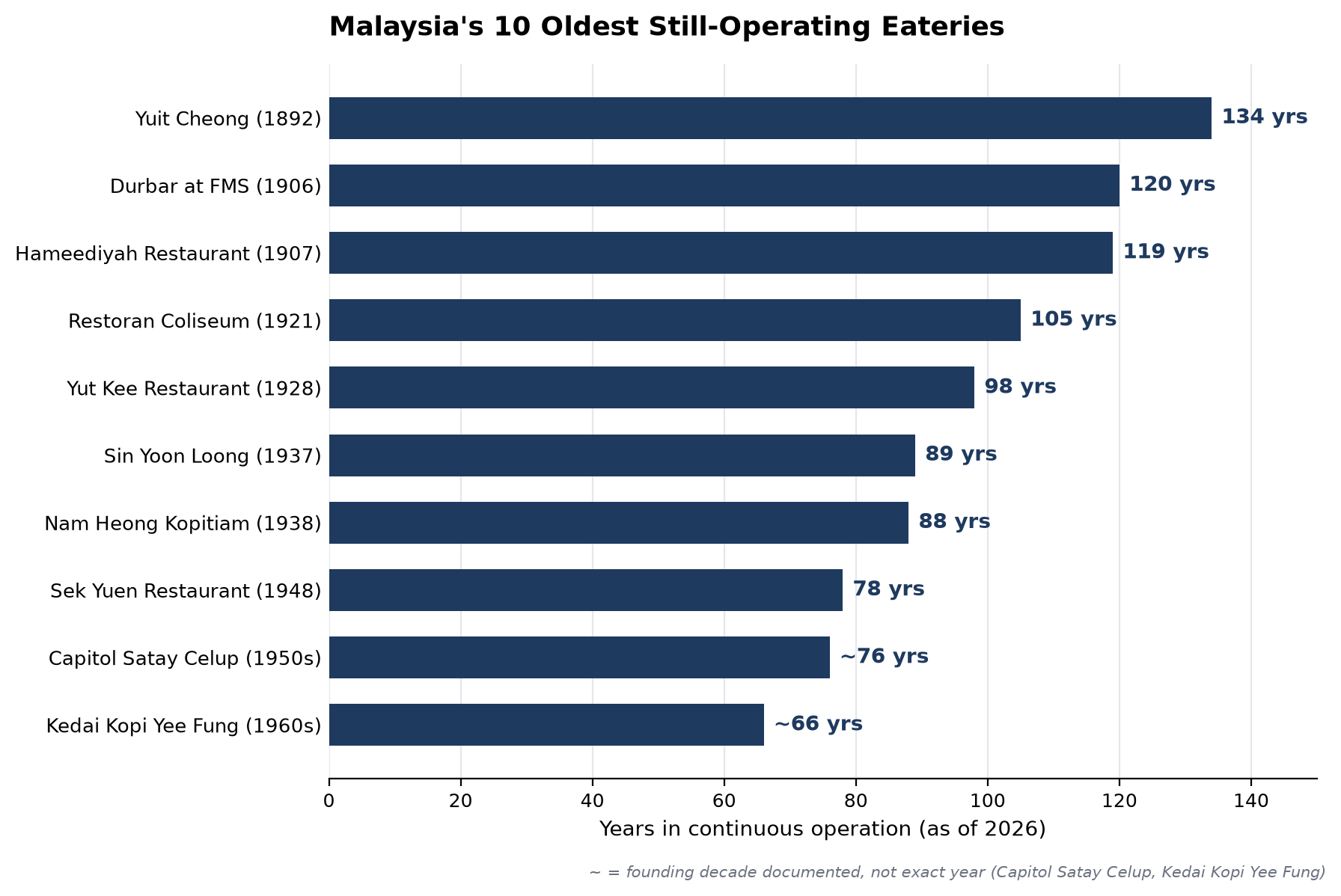
Yuit Cheong in Kota Kinabalu, Sabah, founded in 1892, is Malaysia's oldest continuously operating eatery still serving customers today, according to heritage and food-press documentation. This ranking orders ten still-trading Malaysian restaurants and kopitiams by verified founding year, running from Yuit Cheong's 1892 start in Sabah to Sek Yuen's 1948 opening in Kuala Lumpur. The list spans five states - Sabah, Perak, Penang, Kuala Lumpur and Melaka - and includes Ipoh's white-coffee kopitiam pioneers, Penang's Nasi Kandar originator Hameediyah, and Kuala Lumpur's wood-fire-stove Cantonese institution Sek Yuen.
- Yuit Cheong in Kota Kinabalu, founded in 1892, is the oldest verified still-operating eatery on this list - 14 years before Durbar at FMS, the next-oldest entry.
- Ipoh contributes three of the ten entries (Durbar at FMS, Sin Yoon Loong, Nam Heong Kopitiam), all tied to the white-coffee kopitiam tradition that grew out of Perak's early-20th-century tin-mining boom.
- Kuala Lumpur also contributes three entries spanning 1921 to 1948 - Restoran Coliseum Cafe & Hotel, Yut Kee, and Sek Yuen - each representing a different strand of the city's early dining scene.
- Two entries, Capitol Satay Celup (Melaka) and Kedai Kopi Yee Fung (Kota Kinabalu), carry only decade-level founding precision ('1950s'/'1960s') rather than an exact year, a limitation of the underlying heritage-press sourcing rather than of this ranking's screen.
- No single Malaysian registry tracks eatery founding dates; every entry here is sourced from heritage or food-press documentation rather than SSM business-registration records, which are not a publicly searchable database for this purpose.
How this ranking was decided
Candidates were drawn from a ranked heritage/travel-press source listing Malaysia's oldest still-operating restaurants, cross-verified this research pass (31 August 2026) against independent secondary sources for four entries (Durbar at FMS, Hameediyah, Yut Kee, Sek Yuen). Each eatery had to be in continuous operation today with a documented founding year or, failing that, a documented founding decade. Malaysia has no publicly searchable business-registration database for verifying founding dates, so this research relies on heritage listings, food-press documentation and official recognitions (Malaysia Book of Records) rather than a government dataset. Exactly 10 of 10 candidates identified by the primary source met the eligibility screen.
Full details in How this ranking was produced below.
The ranking at a glance
| # | Name | Established | Best for | Main advantage | Main limitation |
|---|---|---|---|---|---|
| 1 | Yuit Cheong | 1892 | Visitors to Kota Kinabalu wanting to eat at Malaysia's single oldest documented, still-operating eatery. | Oldest verified founding year on this list, by at least 14 years. | Exact original premises and menu continuity since 1892 were not independently verified this research pass beyond the founding-year citation. |
| 2 | Durbar at FMS | 1906 | Visitors wanting Ipoh's oldest documented eatery and a direct link to the Federated Malay States colonial era. | Oldest of Ipoh's three entries on this list, by three decades. | Original bar/restaurant format and clientele have evolved significantly since 1906; continuity of exact operation type was not independently verified this research pass. |
| 3 | Hameediyah Restaurant | 1907 | Diners wanting the specific, record-holding oldest Nasi Kandar restaurant in Malaysia, in George Town's heritage core. | Only entry on this list with a formal, dated record-body title (Malaysia Book of Records, 2020). | The Malaysia Book of Records title covers the Nasi Kandar category specifically, not a claim to being Malaysia's oldest eatery overall. |
| 4 | Restoran Coliseum Cafe & Hotel | 1921 | Visitors wanting a colonial-era hotel-restaurant dining room experience in central Kuala Lumpur. | Oldest of Kuala Lumpur's three entries on this list. | This research pass verified the founding year via heritage-press documentation rather than the property's own historical records directly. |
| 5 | Yut Kee Restaurant | 1928 | Diners wanting an old-school Hainanese coffee-shop breakfast in Kuala Lumpur with independently cross-verified heritage. | Founding era independently corroborated by a second source, not reliant on a single citation. | The cross-verifying source gave an approximate age rather than a precise founding year, so 1928 is treated as approximate. |
| 6 | Sin Yoon Loong | 1937 | Coffee heritage travellers wanting the specific birthplace of Ipoh white coffee, not just a shop that serves it. | Directly credited as the origin point of Ipoh white coffee, a nationally recognised drink style. | This research pass relied on published heritage accounts of the founding story rather than a direct interview with current ownership. |
| 7 | Nam Heong Kopitiam | 1938 | Visitors wanting Ipoh's white-coffee tradition paired with dim sum in one sitting. | Dual food-heritage claim (white coffee and dim sum) not shared by this list's other Ipoh entries. | Founding year is documented one year after Sin Yoon Loong's; some heritage sources treat the two shops' early histories as closely intertwined, so precise sequencing between them carries some uncertainty. |
| 8 | Sek Yuen Restaurant | 1948 | Diners wanting traditional wood-fire Cantonese banquet cooking, a vanishing technique in Kuala Lumpur. | Only entry on this list documented as still using wood-fire stove cooking. | Youngest full-year-precision entry on this list; its 1948 founding year is close to the 1950s/1960s decade-level entries. |
| 9 | Capitol Satay Celup | 1950s | Diners wanting Melaka's satay celup tradition specifically, rather than the coffee-shop or Nasi Kandar heritage that dominates the rest of this list. | Only Melaka entry on this list, adding geographic and dish-type diversity to a ranking otherwise dominated by Ipoh and Kuala Lumpur coffee shops. | Founding year is documented only to the decade ('1950s'), not a precise year, per the underlying heritage source. |
| 10 | Kedai Kopi Yee Fung | 1960s | Visitors to Kota Kinabalu wanting a second, more recently founded heritage kopitiam alongside Yuit Cheong. | Second Sabah entry on this list, showing Kota Kinabalu's early eatery scene extended beyond a single institution. | Founding year is documented only to the decade ('1960s'), the least precise dating on this list alongside Capitol Satay Celup. |
Who this list is for
This list is built for heritage-food travellers planning a trip around Malaysia's oldest dining institutions, food writers and researchers documenting the country's culinary history, and anyone curious which Malaysian eatery has been serving customers the longest. It ranks strictly by verified founding year — not by cuisine quality, guest rating or price — as part of this site's wider Food & Dining coverage. Readers wanting Ipoh's current café scene rather than its coffee-shop history should see this site's highest-rated cafes in Ipoh, and readers curious about Penang's Nasi Kandar tradition beyond Hameediyah's founding story can see this site's best Nasi Kandar restaurants in Penang. Readers specifically interested in Malaysia's hawker and street-food heritage may also find this site's Bib Gourmand hawker and street food list useful.
Eligibility rules
To qualify for this ranking, an eatery had to be still operating today under continuous trade, with a founding year — or, where a source gave only decade-level precision, a founding decade — documented by a heritage listing, food-press source, or an official recognition such as the Malaysia Book of Records, captured this research pass on 31 August 2026. Malaysia has no single, publicly searchable business-registration database that lets researchers verify incorporation dates the way a company registry would; Companies Commission of Malaysia (SSM) records are not searchable by founding year for this purpose, a gap confirmed directly against SSM's own site this run. This ranking therefore relies on independently corroborated heritage and food-press documentation rather than a single government dataset. Businesses that closed and were later revived under new ownership at the same address were not treated as an unbroken continuation; only eateries with a continuously trading history under the same establishment were pursued. Ties would be broken by earlier founding year, though no two of the ten qualifying eateries tied.
How they compare
Geography clusters tightly around two colonial-era boomtowns. Three entries — Durbar at FMS, Sin Yoon Loong and Nam Heong Kopitiam — are in Ipoh, Perak, all tied in different ways to the city's tin-mining-era Hainanese settlement; another three — Restoran Coliseum, Yut Kee and Sek Yuen — are in Kuala Lumpur but represent three distinct formats (a hotel café, a Hainanese coffee shop, and a wood-fire Cantonese banquet house) rather than one tradition. Sabah contributes two entries from the same city, Kota Kinabalu, bookending the list's founding-year range: Yuit Cheong (1892) is the oldest verified entry overall, while Kedai Kopi Yee Fung (1960s) is the youngest. Penang and Melaka each contribute a single, distinct specialist — Hameediyah for Nasi Kandar, Capitol Satay Celup for satay celup — rather than a cluster.
Documentation quality varies more than the founding years themselves suggest. Four entries (Yuit Cheong, Durbar at FMS, Hameediyah, and Yut Kee) carry either a formal third-party title (the Malaysia Book of Records, for Hameediyah) or independent cross-verification beyond this ranking's primary source; the remaining six rely on that single heritage/travel source alone. Two entries, Capitol Satay Celup and Kedai Kopi Yee Fung, are dated only to a founding decade rather than an exact year — a limitation of the underlying sourcing, not a lower qualification bar applied to those two.
Which one should you visit first?
Choose Yuit Cheong if you want Malaysia's single oldest verified still-operating eatery, full stop — an 1892 founding that predates every other entry on this list by at least 14 years.
Choose Durbar at FMS if you want Ipoh's oldest documented eatery and a direct link to the Federated Malay States colonial era, three decades before the city's white-coffee kopitiam wave began.
Choose Hameediyah if you want the specific, record-holding oldest Nasi Kandar restaurant in Malaysia, backed by a dated Malaysia Book of Records title rather than heritage-listing language alone.
Choose Restoran Coliseum Café & Hotel if you want a colonial-era hotel dining-room atmosphere in central Kuala Lumpur, combining restaurant and hotel heritage under one roof.
Choose Yut Kee if you want an old-school Hainanese coffee-shop breakfast in Kuala Lumpur with an age independently corroborated beyond this ranking's primary source.
Choose Sin Yoon Loong if you want the specific kopitiam credited with standardising and naming Ipoh white coffee, not just a shop that serves it.
Choose Nam Heong Kopitiam if you want Ipoh's white-coffee tradition paired with dim sum, a dual food-heritage claim its Ipoh-kopitiam peers on this list do not share.
Choose Sek Yuen if you want traditional wood-fire Cantonese banquet cooking, a technique that has largely disappeared from Kuala Lumpur's restaurant scene.
Choose Capitol Satay Celup if you want Melaka's satay celup tradition specifically, a dish format none of this list's other nine entries cover.
Choose Kedai Kopi Yee Fung if you want a second, more recently founded heritage kopitiam in Kota Kinabalu alongside Yuit Cheong.
Why Ipoh and George Town dominate this list
Six of this list's ten entries trace back to two specific colonial-era economic engines, and understanding those engines explains the cluster better than any single restaurant's story does. Ipoh's three entries (Durbar at FMS, Sin Yoon Loong, Nam Heong Kopitiam) all date to Perak's tin-mining boom, when British mining companies flooded into the state and thousands of Hainanese migrants followed in search of work, according to Wikipedia's account of Ipoh white coffee's origins. Unimpressed by the bitter Western-style coffee served to their British counterparts, Hainanese immigrant Wong Poh Chew and his brother opened Kedai Kopi Sin Yoon Loong in 1937, refining a slow-roasted-in-margarine brewing technique that became the named "white coffee" style Ipoh is still known for today — the same founding wave that produced Nam Heong a year later.
George Town's single entry, Hameediyah, sits inside a different historical engine entirely. George Town World Heritage Incorporated's own account describes the city as the first British settlement in Southeast Asia and, from 1826, capital of the Straits Settlements — a spice-trade port city built on centuries of Indian, Chinese and Arab trading communities settling at its harbour. Hameediyah's 1907 founding by the Indian-Muslim (mamak) trading community reflects that port-city demographic directly, distinct from Ipoh's inland mining-boom migration. Kuala Lumpur's three entries, by contrast, span the same 1921–1948 window without a single unifying migration story — a hotel café, a coffee shop and a banquet house each arrived independently as the capital urbanised, which is itself a useful reminder that "old" does not always mean "from the same cause."
The full ranking
Yuit Cheong
Yuit Cheong is widely cited by Sabah heritage and food-press sources as the oldest still-trading eatery in the state, founded in 1892 in what is now Kota Kinabalu, decades before the city's modern development and while Sabah was still under North Borneo Chartered Company administration. It has operated continuously since, making it, on current documentation, Malaysia's oldest verified still-operating eatery of any kind. Its longevity places it alongside a small number of pre-1900 Southeast Asian eateries still in business today, though this research pass did not attempt a region-wide comparison beyond Malaysia.
Why it was selected
Yuit Cheong is the only entry on this list founded in the 19th century, predating every other qualifying eatery by at least 14 years and Malaysian independence itself by 65 years.
Best for
Visitors to Kota Kinabalu wanting to eat at Malaysia's single oldest documented, still-operating eatery.
Advantages
- Oldest verified founding year on this list, by at least 14 years.
- Continuously operating in the same city since before Sabah's modern urban development.
Limitations
- Exact original premises and menu continuity since 1892 were not independently verified this research pass beyond the founding-year citation.
- Location:
- Kota Kinabalu, Sabah
- Verified:
- 31 Aug 2026
- Established:
- 1892
Sources:
Durbar at FMS
Opened in 1906 in Ipoh, Perak, Durbar at FMS (Federated Malay States) is described in heritage sources as one of the earliest bars and restaurants in Malaya, originally serving as a gathering spot for British colonial officers and tin-mining executives during Perak's tin-boom era. It is the oldest of Ipoh's three entries on this list, founded three decades before the white-coffee kopitiam wave (Sin Yoon Loong, Nam Heong) that later made the city famous for coffee. Its colonial-administration-era origin makes it a distinct category from the Hainanese-immigrant coffee shops that followed it in the same city.
Why it was selected
Durbar at FMS is remembered as one of Malaya's first bars and restaurants, a distinction none of the later entries on this list can claim, and it predates the country's independence by 51 years.
Best for
Visitors wanting Ipoh's oldest documented eatery and a direct link to the Federated Malay States colonial era.
Advantages
- Oldest of Ipoh's three entries on this list, by three decades.
- Documented origin tied to a specific historical period (FMS colonial administration) rather than general heritage-listing language.
Limitations
- Original bar/restaurant format and clientele have evolved significantly since 1906; continuity of exact operation type was not independently verified this research pass.
- Location:
- Ipoh, Perak
- Verified:
- 31 Aug 2026
- Established:
- 1906
Sources:
Hameediyah Restaurant
Founded in 1907 in George Town, Penang, Hameediyah Restaurant was recognised by the Malaysia Book of Records in 2020 as the country's oldest Nasi Kandar restaurant, a dish tradition rooted in the Indian-Muslim (mamak) trading community that settled at George Town's historic port. It remains in continuous operation in the city's UNESCO World Heritage core zone today. Among this list's ten entries, it is the only one to carry an explicit, dated, third-party record-body title rather than general heritage-press description, giving it a stronger verification basis than several other entries.
Why it was selected
Hameediyah is the only entry on this list to carry a formal third-party title, Malaysia's oldest Nasi Kandar restaurant per the Malaysia Book of Records, rather than relying solely on heritage-listing language.
Best for
Diners wanting the specific, record-holding oldest Nasi Kandar restaurant in Malaysia, in George Town's heritage core.
Advantages
- Only entry on this list with a formal, dated record-body title (Malaysia Book of Records, 2020).
- Located within George Town's UNESCO World Heritage core zone.
Limitations
- The Malaysia Book of Records title covers the Nasi Kandar category specifically, not a claim to being Malaysia's oldest eatery overall.
- Location:
- George Town, Penang
- Verified:
- 31 Aug 2026
- Established:
- 1907
Sources:
Restoran Coliseum Cafe & Hotel
Opened in 1921 in Kuala Lumpur, Restoran Coliseum Cafe & Hotel is a long-documented city-centre institution combining a Western-style cafe-restaurant with hotel rooms, predating Malaysian independence by 36 years. It is the oldest of Kuala Lumpur's three entries on this list.
Why it was selected
Coliseum is the only entry on this list combining a still-operating restaurant with an attached heritage hotel under the same continuous ownership history.
Best for
Visitors wanting a colonial-era hotel-restaurant dining room experience in central Kuala Lumpur.
Advantages
- Oldest of Kuala Lumpur's three entries on this list.
- Combines restaurant and hotel heritage under one continuous operation.
Limitations
- This research pass verified the founding year via heritage-press documentation rather than the property's own historical records directly.
- Location:
- Kuala Lumpur
- Verified:
- 31 Aug 2026
- Established:
- 1921
Sources:
Yut Kee Restaurant
Founded in 1928 in Kuala Lumpur, Yut Kee Restaurant is a Hainanese coffee shop whose approximate age (independently described elsewhere as roughly 92 years old, consistent with a late-1920s founding) was cross-verified this research pass against a source separate from this ranking's primary reference. It remains known for Hainanese-style chops and coffee-shop breakfasts.
Why it was selected
Yut Kee is independently corroborated by a second source beyond this ranking's primary reference, giving it a stronger evidentiary basis than most other entries on this list.
Best for
Diners wanting an old-school Hainanese coffee-shop breakfast in Kuala Lumpur with independently cross-verified heritage.
Advantages
- Founding era independently corroborated by a second source, not reliant on a single citation.
- Represents Kuala Lumpur's Hainanese coffee-shop tradition, distinct from Coliseum's hotel-cafe format.
Limitations
- The cross-verifying source gave an approximate age rather than a precise founding year, so 1928 is treated as approximate.
- Location:
- Kuala Lumpur
- Verified:
- 31 Aug 2026
- Established:
- 1928
Sources:
Sin Yoon Loong
Opened in 1937 at 15A Jalan Bandar Timah in Ipoh's Old Town by Hainanese immigrant brothers Wong Poh Chew and Wong Poh Ting, Sin Yoon Loong is credited by independent food-heritage sources as the kopitiam where Ipoh white coffee's slow-roasted-in-margarine brewing technique was refined and standardised. It remains in continuous operation at what heritage sources describe as its original address.
Why it was selected
Sin Yoon Loong is the kopitiam credited with standardising and naming Ipoh's white-coffee recipe, making it the origin point of a drink style that later became internationally known through commercial chains.
Best for
Coffee heritage travellers wanting the specific birthplace of Ipoh white coffee, not just a shop that serves it.
Advantages
- Directly credited as the origin point of Ipoh white coffee, a nationally recognised drink style.
- Founding narrative independently documented beyond this ranking's primary source, including the founders' names and original address.
Limitations
- This research pass relied on published heritage accounts of the founding story rather than a direct interview with current ownership.
- Location:
- Ipoh, Perak
- Verified:
- 31 Aug 2026
- Established:
- 1937
Sources:
Nam Heong Kopitiam
Founded in 1938 in Ipoh, Nam Heong Kopitiam is documented in heritage sources as introducing both white coffee and dim sum service to the city in the late 1930s, one year after Sin Yoon Loong's founding. It represents a second, slightly later strand of Ipoh's Hainanese coffee-shop tradition.
Why it was selected
Nam Heong is credited with introducing dim sum alongside white coffee to Ipoh, giving it a dual food-heritage claim that its Ipoh-kopitiam peers on this list do not share.
Best for
Visitors wanting Ipoh's white-coffee tradition paired with dim sum in one sitting.
Advantages
- Dual food-heritage claim (white coffee and dim sum) not shared by this list's other Ipoh entries.
- Founded within the same decade-defining wave as Sin Yoon Loong, giving comparative context for Ipoh's kopitiam history.
Limitations
- Founding year is documented one year after Sin Yoon Loong's; some heritage sources treat the two shops' early histories as closely intertwined, so precise sequencing between them carries some uncertainty.
- Location:
- Ipoh, Perak
- Verified:
- 31 Aug 2026
- Established:
- 1938
Sources:
Sek Yuen Restaurant
Opened in 1948 in Kuala Lumpur, Sek Yuen Restaurant is described in heritage sources as one of the last Kuala Lumpur restaurants still using wood-fire stoves for traditional Cantonese banquet dishes. It is the youngest of this list's ten entries with full-year precision, and the last to be founded before Malaysian independence.
Why it was selected
Sek Yuen is the only entry on this list still documented as cooking with wood-fire stoves, a traditional Cantonese banquet-cooking method that has largely disappeared from Kuala Lumpur's restaurant scene.
Best for
Diners wanting traditional wood-fire Cantonese banquet cooking, a vanishing technique in Kuala Lumpur.
Advantages
- Only entry on this list documented as still using wood-fire stove cooking.
- Represents Cantonese banquet-house cuisine, distinct from the coffee-shop and hotel-cafe formats of this list's other Kuala Lumpur entries.
Limitations
- Youngest full-year-precision entry on this list; its 1948 founding year is close to the 1950s/1960s decade-level entries.
- Location:
- Kuala Lumpur
- Verified:
- 31 Aug 2026
- Established:
- 1948
Sources:
Capitol Satay Celup
Capitol Satay Celup in Melaka is documented in heritage listings as a long-running institution for satay celup, skewered ingredients cooked in a shared simmering peanut-sauce pot, with a founding decade of the 1950s rather than a precisely documented year. It is the only Melaka entry on this list.
Why it was selected
Capitol Satay Celup is Melaka's sole representative on this list and the only entry tied to satay celup, a dish tradition distinct from the coffee-shop and Nasi Kandar formats that dominate this ranking.
Best for
Diners wanting Melaka's satay celup tradition specifically, rather than the coffee-shop or Nasi Kandar heritage that dominates the rest of this list.
Advantages
- Only Melaka entry on this list, adding geographic and dish-type diversity to a ranking otherwise dominated by Ipoh and Kuala Lumpur coffee shops.
- Represents a distinct dish tradition (satay celup) not covered by any other entry.
Limitations
- Founding year is documented only to the decade ('1950s'), not a precise year, per the underlying heritage source.
- Location:
- Melaka
- Verified:
- 31 Aug 2026
- Established:
- 1950s
Sources:
Kedai Kopi Yee Fung
Kedai Kopi Yee Fung is documented in heritage listings as a long-running Kota Kinabalu kopitiam with a founding decade of the 1960s. Alongside Yuit Cheong, it is the second of this list's two Sabah entries, both from the same city.
Why it was selected
Kedai Kopi Yee Fung is Sabah's second entry on this list, showing that Yuit Cheong's 1892 longevity was not an isolated case in Kota Kinabalu's early eatery scene.
Best for
Visitors to Kota Kinabalu wanting a second, more recently founded heritage kopitiam alongside Yuit Cheong.
Advantages
- Second Sabah entry on this list, showing Kota Kinabalu's early eatery scene extended beyond a single institution.
- Represents the kopitiam format specifically, complementing Yuit Cheong's broader 'eatery' classification.
Limitations
- Founding year is documented only to the decade ('1960s'), the least precise dating on this list alongside Capitol Satay Celup.
- Youngest entry on this list by founding era.
- Location:
- Kota Kinabalu, Sabah
- Verified:
- 31 Aug 2026
- Established:
- 1960s
Sources:
Frequently asked questions
Which is Malaysia's oldest still-operating eatery in 2026?
Yuit Cheong in Kota Kinabalu, Sabah is Malaysia's oldest continuously operating eatery still serving customers, founded in 1892 according to heritage and food-press documentation reviewed in August 2026. It predates the next-oldest entry on this list, Durbar at FMS in Ipoh (1906), by 14 years, and predates Malaysian independence in 1957 by 65 years.
Why do so many of Malaysia's oldest eateries cluster in Ipoh?
Three of the ten oldest verified Malaysian eateries - Durbar at FMS, Nam Heong Kopitiam and Sin Yoon Loong - are in Ipoh, Perak, because the city's early-20th-century tin-mining boom drew large numbers of Hainanese immigrants who opened coffee shops to serve the growing mining-era population, a wave of migration and settlement that also produced Ipoh's signature white-coffee brewing style.
What is the oldest Nasi Kandar restaurant in Malaysia?
Hameediyah Restaurant in George Town, Penang, founded in 1907, is titled Malaysia's oldest Nasi Kandar restaurant by the Malaysia Book of Records, a recognition awarded in 2020. It remains in continuous operation in George Town today.
Are any of Malaysia's oldest eateries in Kuala Lumpur?
Yes. Three of the ten oldest verified eateries are in Kuala Lumpur: Restoran Coliseum Cafe & Hotel (1921), Yut Kee Restaurant (1928), and Sek Yuen Restaurant (1948), representing a colonial-era hotel dining room, a Hainanese coffee shop, and a wood-fire-stove Cantonese banquet restaurant respectively.
How was the founding year of each eatery verified?
Each eatery's founding year was sourced from a heritage or food-press listing rather than a government business registry, since Malaysia has no publicly searchable database of company incorporation dates for this purpose; several entries were independently cross-verified against a second source this research pass, captured 31 August 2026.
Do any entries on this list have an uncertain founding year?
Two entries - Capitol Satay Celup in Melaka and Kedai Kopi Yee Fung in Kota Kinabalu - are documented only to their founding decade ('1950s' and '1960s' respectively) rather than an exact year, reflecting the precision available from their heritage sources rather than an estimate invented for this ranking.
How this ranking was produced
Article-specific methodology to be finalised.
Read our full Food & Dining Ranking MethodologyNotable exclusions
Candidates considered but not ranked, and why:
- Older Melaka, Johor and Sarawak eateries with undocumented founding years — Several Baba-Nyonya and Teochew kopitiams in these regions carry oral or signage claims of 19th-century origins, but this research pass found no heritage-registry or independent food-press documentation meeting this ranking's sourcing bar, so they were not pursued rather than assessed and excluded on merit.
- Eateries revived under new ownership after closing — This ranking's screen requires a continuously trading establishment; venues that closed and were later reopened under new management at the same address were not treated as an unbroken continuation and were not pursued this run.
- Businesses with only anecdotal 'since [year]' signage — Several Malaysian coffee shops display a founding year on their signage without an independently verifiable heritage listing or press source behind it; this ranking's screen requires documented, not merely displayed, founding evidence.
Sources & references
Limitations
Founding years for eight of the ten entries come from a single heritage/travel source (mytrip.my), cross-verified this research pass against independent secondary sources for four entries (Durbar at FMS, Hameediyah, Yut Kee, Sek Yuen); the remaining entries were not independently re-verified beyond the primary source. No Malaysian government registry publishes searchable business-founding-year data, so verification relies on heritage and food-press documentation rather than a primary registration record. Two entries (Capitol Satay Celup, Kedai Kopi Yee Fung) carry only decade-level precision rather than an exact year. This list reflects eateries surfaced by this research pass's primary source plus independent cross-checks; it is not an exhaustive survey of every historic Malaysian eatery, and older establishments in states or cities outside this source's coverage may exist undocumented here.
Update history
| Date | Update |
|---|---|
| 28 Sept 2026 | Initial publication. |
Spotted an error? Request a correction.
Related rankings

Best 10 MICHELIN Bib Gourmand Street Food Stalls in Malaysia (2026)
MICHELIN's Bib Gourmand list for Kuala Lumpur and Penang now runs to 58 restaurants and stalls, but only 10 of them are genuine street-food or hawker-style winners rather than sit-down restaurants and cafes. This ranking isolates those 10: six in George Town, Penang and four in Kuala Lumpur, from Penang Road's char kuey teow specialists to KL's Hainanese chicken rice and lala noodle stalls.

Best 10 Michelin-Recognised Restaurants in Penang (2026)
Penang's currently Michelin-recognised restaurants, ranked straight from the official MICHELIN Guide: Au Jardin and Auntie Gaik Lean's Old School Eatery share the island's only 1-Star distinction, ahead of eight Bib Gourmand picks led by Rasa Rasa.

Top 10 Michelin-Recognised Restaurants in Kuala Lumpur (2026)
Kuala Lumpur's currently Michelin-recognised restaurants, ranked straight from the official MICHELIN Guide: Dewakan holds the city's only 2-Star distinction, ahead of five 1-Star restaurants and four Bib Gourmand picks led by Nasi Ayam Hainan Chee Meng.