
Top 14 UNESCO-Recognised Sites in Malaysia (2026)
Every World Heritage Site, UNESCO Global Geopark and Biosphere Reserve formally inscribed in Malaysia, ordered by year of recognition — for travellers planning a heritage-focused trip. Captured 1 September 2026.

Quick answer
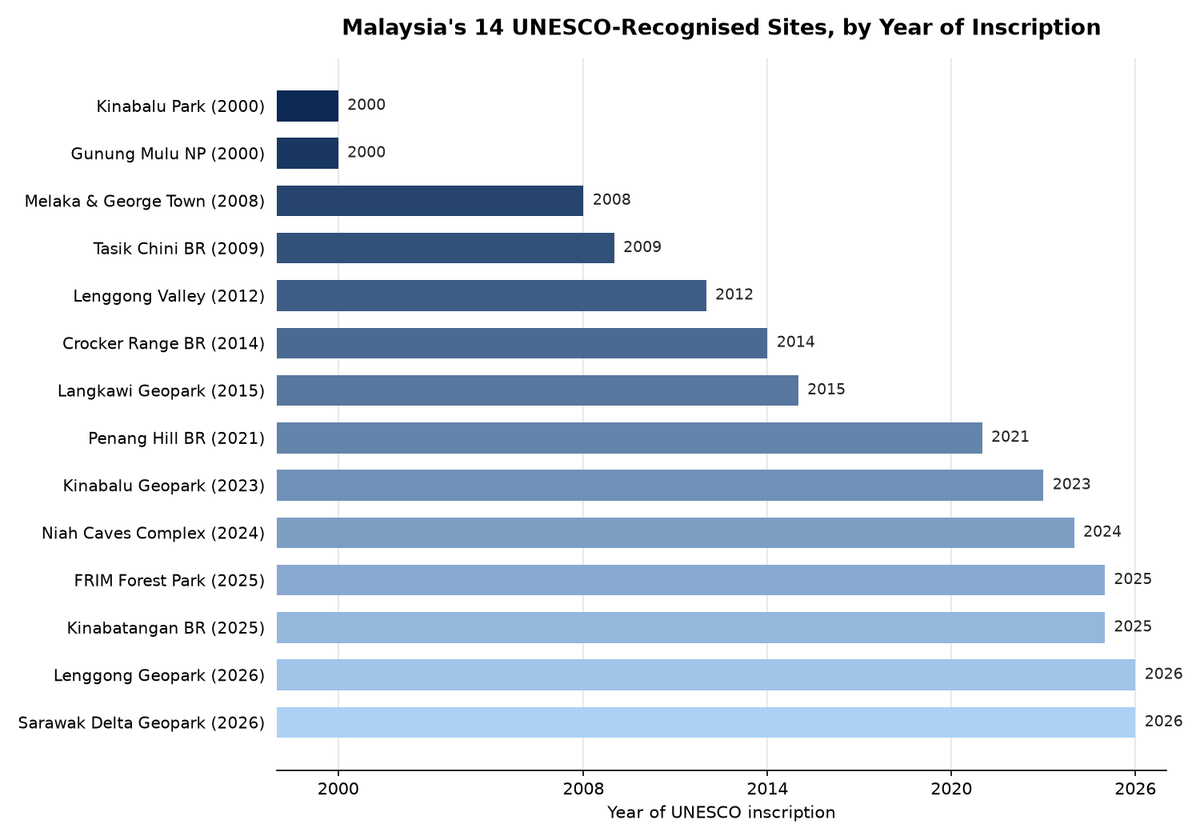
Malaysia holds 14 formally inscribed UNESCO designations as of September 2026: 6 World Heritage Sites, 4 UNESCO Global Geoparks and 4 Biosphere Reserves. Kinabalu Park (Sabah) and Gunung Mulu National Park (Sarawak) are the oldest, both inscribed as Natural World Heritage Sites in 2000. The most recent are the Lenggong and Sarawak Delta UNESCO Global Geoparks, both named in 2026. Two locations carry two separate, overlapping UNESCO designations under different programmes: Kinabalu Park/Geopark and the Lenggong Valley World Heritage Site/Geopark. Taman Negara remains on UNESCO's Tentative List only and is not yet formally inscribed.
- Malaysia holds 14 formally inscribed UNESCO designations across three separate programmes — 6 World Heritage Sites, 4 Global Geoparks and 4 Biosphere Reserves — not one unified 'UNESCO sites' list.
- Kinabalu Park (Sabah) and Gunung Mulu National Park (Sarawak) are Malaysia's oldest UNESCO recognitions, both inscribed as Natural World Heritage Sites in 2000.
- Two districts hold two separate, overlapping UNESCO designations under different programmes: Kinabalu Park (World Heritage Site, 2000) and Kinabalu Geopark (2023); Lenggong Valley (World Heritage Site, 2012) and Lenggong Geopark (2026).
- 2025-2026 was Malaysia's busiest stretch of new UNESCO recognition on record: FRIM Forest Park, Kinabatangan Biosphere Reserve, and the Lenggong and Sarawak Delta Global Geoparks were all named within an 18-month window.
- Taman Negara, Malaysia's most visited national park, is not on this list — it sits on UNESCO's Tentative List only and has not been formally inscribed.
How this ranking was decided
A data ranking. 14 UNESCO-inscribed sites in Malaysia (World Heritage Sites, Global Geoparks, Biosphere Reserves) were identified via UNESCO's own published records and ordered by year of inscription, with larger property area as the tie-break for same-year entries, captured 1 September 2026. Sites on UNESCO's Tentative List only, such as Taman Negara, do not qualify.
Full details in How this ranking was produced below.
The ranking at a glance
| # | Name | Year inscribed | Best for | Main advantage | Main limitation |
|---|---|---|---|---|---|
| 1 | Kinabalu Park | 2000 | Serious hikers and biodiversity-focused travellers planning a multi-day summit attempt or botanical trip. | Largest protected area by hectare among Malaysia's Natural World Heritage Sites (75,370 ha). | Summit climbs require advance permits and a mandatory guide, and can book out months ahead in peak season. |
| 2 | Gunung Mulu National Park | 2000 | Cavers and adventure travellers seeking one of the world's most significant limestone cave systems. | Home to some of the largest known cave chambers and passages on Earth. | Remote location (fly-in access only) makes it a costlier, multi-day trip relative to Peninsular Malaysia sites. |
| 3 | Melaka and George Town, Historic Cities of the Straits of Malacca | 2008 | City-break travellers wanting a compact, walkable heritage trip rather than a wilderness or multi-day itinerary. | Two distinct historic city cores in one listing, both accessible without a multi-day wilderness trip. | A serial (two-city) listing means seeing 'the whole site' realistically requires visiting both Melaka and George Town separately. |
| 4 | Tasik Chini Biosphere Reserve | 2009 | Travellers interested in freshwater wetland ecology and Orang Asli cultural context, over a purely scenic lake visit. | Malaysia's first Biosphere Reserve, opening the MAB programme's presence in the country in 2009. | Smallest property area of Malaysia's four Biosphere Reserves at 6,923 ha, limiting how much can be covered in a single visit. |
| 5 | Archaeological Heritage of the Lenggong Valley | 2012 | History and archaeology travellers, rather than those seeking a scenic-nature day trip. | Contains Southeast Asia's oldest and most complete human skeleton, 'Perak Man.' | A working archaeological site rather than a resort-style destination — visitor infrastructure is more limited than at Melaka/George Town. |
| 6 | Crocker Range Biosphere Reserve | 2014 | Travellers with an interest in Sabah's interior highlands and watershed ecology, beyond the more commercial Kinabalu Park corridor. | Largest of Malaysia's four Biosphere Reserves at 350,584 ha. | Less developed for casual tourism than neighbouring Kinabalu Park, with fewer marked trails and visitor facilities. |
| 7 | Langkawi UNESCO Global Geopark | 2015 | Family beach holidays that want an accessible geology or nature-tourism layer added on, not a dedicated geology expedition. | Malaysia's first UNESCO Global Geopark, designated in 2015. | Its long-standing tourism development means some geosites are more commercialised than Malaysia's newer, less-visited geoparks. |
| 8 | Penang Hill Biosphere Reserve | 2021 | Travellers who want a nature and biodiversity element added to a George Town city trip without extra travel days. | Malaysia's most urban-adjacent Biosphere Reserve, directly reachable from George Town by funicular railway. | Smaller and more visited than Malaysia's rural Biosphere Reserves, with less true wilderness character. |
| 9 | Kinabalu UNESCO Global Geopark | 2023 | Travellers with a specific interest in Mount Kinabalu's geology and granite pluton formation, on top of an existing Kinabalu Park visit. | Recognises Mount Kinabalu's distinct geological formation as one of the youngest non-volcanic granite mountains on Earth. | Because it overlaps an existing, better-known World Heritage Site, its Geopark-specific visitor trails and signage are less developed than the park's main hiking routes. |
| 10 | Archaeological Heritage of Niah National Park's Caves Complex | 2024 | Deep-history travellers who want Sarawak's archaeological record alongside, or instead of, Gunung Mulu's caving. | Evidence of continuous human presence spanning more than 40,000 years. | One of Malaysia's most recently inscribed sites (2024), so visitor infrastructure and guiding are still developing relative to longer-established sites. |
| 11 | FRIM Forest Park Selangor | 2025 | Travellers based in or near Kuala Lumpur wanting a UNESCO-recognised site reachable as a half-day trip rather than a multi-day expedition. | Most accessible of Malaysia's Natural World Heritage Sites from Kuala Lumpur, reachable as a half-day trip. | Smallest World Heritage property in Malaysia at 545 ha, offering a shorter and less immersive visit than Sabah or Sarawak's larger natural sites. |
| 12 | Kinabatangan Biosphere Reserve | 2025 | Wildlife-focused travellers prioritising river-cruise sightings of orangutans, pygmy elephants and proboscis monkeys over hiking. | Among Borneo's highest concentrations of orangutans, pygmy elephants and proboscis monkeys, viewable by river cruise. | As one of the newest reserves (September 2025), some zoning and visitor-management infrastructure is still being finalised. |
| 13 | Lenggong UNESCO Global Geopark | 2026 | Travellers who have already visited the Lenggong Valley's archaeological sites and want the geological context behind them. | Adds a geological dimension to a district already known for archaeology, without requiring a separate trip. | As a 2026 designation, dedicated Geopark visitor infrastructure separate from the existing archaeological-site facilities is not yet established. |
| 14 | Sarawak Delta UNESCO Global Geopark | 2026 | Geology specialists and independent travellers seeking Malaysia's least commercially developed UNESCO site. | 28 distinct geosites in one Geopark, the largest single-site count among Malaysia's four Geoparks. | As Malaysia's newest UNESCO site, visitor infrastructure, guiding and signage are the least developed of any entry on this list. |
Malaysia's UNESCO recognition is not one list but three separate programmes, each with its own criteria, its own nomination process and its own governing UNESCO body — and this ranking answers a narrow, checkable question: which physical, visitable sites in Malaysia currently hold a formal UNESCO inscription, and when was each one recognised.
A World Heritage Site, a Global Geopark and a Biosphere Reserve are not the same thing
The three programmes represented here protect different things for different reasons, and the distinction matters for a traveller deciding where to go. A World Heritage Site, inscribed by the UNESCO World Heritage Centre under the 1972 World Heritage Convention, recognises "outstanding universal value" in either natural or cultural terms — Gunung Mulu's karst caves and Melaka/George Town's colonial-era streetscape both qualify, but for entirely different reasons, one geological and one architectural-historical. A UNESCO Global Geopark, administered by UNESCO's International Geoscience and Geoparks Programme (IGGP), specifically recognises sites of international geological significance managed under a holistic concept of protection, education and sustainable development — it is a management designation as much as a heritage one, which is why Langkawi and Kinabalu can hold a Geopark label even where part of the same ground already carries a separate World Heritage listing. A Biosphere Reserve, designated under UNESCO's Man and the Biosphere (MAB) Programme, is narrower still: it recognises a model for reconciling conservation with sustainable human use across a zoned landscape, not a single protected monument. Two of Malaysia's 14 entries — Kinabalu and Lenggong — are recognised twice, once under the World Heritage Convention and once under the Geopark programme, because the two schemes evaluate genuinely different qualities of the same ground; neither listing duplicates or supersedes the other, and this ranking keeps both as separate entries with cross-references rather than merging them.
Is this list for you?
This ranking is for anyone planning a heritage- or nature-focused trip in Malaysia who wants to know exactly what is and is not formally UNESCO-recognised, rather than relying on marketing language that stretches the label to any scenic national park. It covers physical sites and protected areas only — UNESCO's separate Intangible Cultural Heritage list (traditions such as Mak Yong theatre or silat) is a different programme recognising practices rather than places, and is out of scope here.
What it took to qualify
To appear on this list, a site had to be formally inscribed by UNESCO under one of three programmes — the World Heritage Convention, the Global Geoparks Network, or the Man and the Biosphere Programme — confirmed against UNESCO's own published records as of 1 September 2026. Sites on UNESCO's Tentative List only, which is a preparatory step before nomination and inscription rather than recognition itself, do not qualify: Taman Negara, Peninsular Malaysia's best-known national park, sits on the Tentative List and was checked and excluded on that basis, despite being commonly assumed to already hold UNESCO status. 14 of the 15 sites identified this cycle cleared the screen, comfortably above this ranking's 10-entry floor.
Malaysia's Top Ten also ranks the country's best national parks, its most scenic waterfalls, and its top islands, all filed under our Travel & Hotels hub.
What separates them
Ordering all 14 by inscription year turns up two clear patterns. First, Malaysia's UNESCO recognition has accelerated sharply in the last three years: six of the 14 entries were inscribed in 2023 or later, compared with six in the entire 15 years from 2009 to 2021 combined. Second, natural-heritage designations dominate by volume — 4 Biosphere Reserves and 3 of 6 World Heritage Sites are natural rather than cultural — but the two oldest and most internationally recognised entries, Kinabalu Park and Gunung Mulu, are also natural sites, both inscribed in the programme's earliest wave for Malaysia in 2000. The cultural World Heritage Sites are geographically distinct from the natural ones: Melaka and George Town (2008) and the Lenggong Valley (2012) sit in Peninsular Malaysia's west coast and historic heartland, while every Biosphere Reserve and Geopark bar Langkawi and Penang Hill sits in East Malaysia or a similarly rural Peninsular setting. Sabah alone holds four of the 14 designations across three different programmes (Kinabalu Park, Crocker Range, Kinabalu Geopark, Kinabatangan), more than any other state — a reflection of Borneo's exceptional and still-expanding biodiversity recognition rather than any single park.
The right pick for your brief
Choose Gunung Mulu National Park if the trip is built around adventure and caving — its Sarawak Chamber and Deer Cave rank among the largest cave passages on Earth. Choose Melaka and George Town if the priority is walkable historic streetscape and a short, accessible city trip rather than a wilderness expedition. Choose Langkawi UNESCO Global Geopark if the brief is a family-friendly beach holiday with an accessible geology angle layered on top — cable cars and beach resorts sit alongside the karst and mangrove geosites. Choose the Lenggong Valley if the interest is deep human prehistory rather than geology or wildlife — it holds Southeast Asia's oldest and most complete human skeleton, "Perak Man." Choose Kinabatangan Biosphere Reserve if wildlife river-cruising (orangutans, pygmy elephants, proboscis monkeys) is the goal over hiking or diving. Choose the Sarawak Delta or Kinabalu Global Geoparks if the interest is genuinely in geology itself — these two are Malaysia's newest and least commercially developed geopark destinations, better suited to a self-directed or guided geology-focused itinerary than a standard resort stay.
The full ranking
Kinabalu Park
Malaysia's tallest mountain and one of its two oldest UNESCO recognitions, protecting 75,370 hectares of exceptional biological diversity around Mount Kinabalu.
Why it was selected
Inscribed in 2000 as one of Malaysia's first two World Heritage Sites, Kinabalu Park protects 75,370 hectares surrounding Mount Kinabalu (4,095m), Malaysia's highest peak and one of the youngest non-volcanic mountains in the world. UNESCO recognised it for exceptional biological diversity spanning distinct altitudinal zones, from lowland dipterocarp forest to alpine meadow. A separate UNESCO Global Geopark covering overlapping ground was designated in 2023 (listed independently below) — a second, geologically-focused recognition of the same area under a different programme, not a duplicate of this listing.
Best for
Serious hikers and biodiversity-focused travellers planning a multi-day summit attempt or botanical trip.
Advantages
- Largest protected area by hectare among Malaysia's Natural World Heritage Sites (75,370 ha).
- Exceptional recorded plant diversity across distinct altitudinal zones.
Limitations
- Summit climbs require advance permits and a mandatory guide, and can book out months ahead in peak season.
- Location:
- Ranau, Sabah
- Website:
- kinabalupark.sabahparks.org.my
- Year inscribed:
- 2000
- Designation type:
- World Heritage Site (Natural)
- Property area:
- 75,370 ha
Sources: Kinabalu Park — source (captured per article methodology)
Gunung Mulu National Park
Sarawak's karst wilderness, inscribed alongside Kinabalu Park in 2000, holding some of the largest known cave chambers and passages on Earth.
Why it was selected
Inscribed in the same 2000 cohort as Kinabalu Park, Gunung Mulu protects 52,864 hectares of equatorial karst, including the Sarawak Chamber — among the largest known underground chambers in the world — and Deer Cave, one of the largest cave passages by volume. UNESCO's inscription cites its exceptional karst landform diversity and cave ecosystems. Its slightly smaller protected area than Kinabalu Park (52,864 ha vs 75,370 ha) is the only reason it sits second rather than first at an identical inscription year.
Best for
Cavers and adventure travellers seeking one of the world's most significant limestone cave systems.
Advantages
- Home to some of the largest known cave chambers and passages on Earth.
- Exceptional karst landform diversity recognised in UNESCO's own inscription criteria.
Limitations
- Remote location (fly-in access only) makes it a costlier, multi-day trip relative to Peninsular Malaysia sites.
- Location:
- Miri Division, Sarawak
- Website:
- mulupark.com
- Year inscribed:
- 2000
- Designation type:
- World Heritage Site (Natural)
- Property area:
- 52,864 ha
Sources: Gunung Mulu National Park — source (captured per article methodology)
Melaka and George Town, Historic Cities of the Straits of Malacca
A serial nomination covering two historic port cities, inscribed in 2008 for over 500 years of trading-route cultural exchange between East and West.
Why it was selected
Inscribed in 2008 as a serial nomination spanning two separate cities rather than one contiguous site, Melaka and George Town were recognised together for a shared, continuous history as trading ports along the Straits of Malacca, shaped by Malay, Chinese, Indian and European cultures over more than 500 years. It is Malaysia's only Cultural World Heritage Site inscribed before 2012 and remains the country's most visited UNESCO property, thanks to its two accessible, walkable city cores.
Best for
City-break travellers wanting a compact, walkable heritage trip rather than a wilderness or multi-day itinerary.
Advantages
- Two distinct historic city cores in one listing, both accessible without a multi-day wilderness trip.
- Continuous, well-documented 500+ year trading history spanning multiple cultures.
Limitations
- A serial (two-city) listing means seeing 'the whole site' realistically requires visiting both Melaka and George Town separately.
- Location:
- Melaka City & George Town, Pulau Pinang
- Website:
- whc.unesco.org/en/list/1223
- Year inscribed:
- 2008
- Designation type:
- World Heritage Site (Cultural)
- Property scope:
- Serial nomination, 2 cities
Tasik Chini Biosphere Reserve
Malaysia's first UNESCO Biosphere Reserve, designated in 2009 around a freshwater lake system in Pahang sacred to local Orang Asli communities.
Why it was selected
Designated in 2009, Tasik Chini was Malaysia's first UNESCO Biosphere Reserve, opening the Man and the Biosphere programme's presence in the country. It protects 6,923 hectares around a 12-lake freshwater system that is both an ecologically significant wetland and a site of cultural importance to the Jakun Orang Asli community, who maintain traditional fishing and settlement rights within the reserve's zoned-use model.
Best for
Travellers interested in freshwater wetland ecology and Orang Asli cultural context, over a purely scenic lake visit.
Advantages
- Malaysia's first Biosphere Reserve, opening the MAB programme's presence in the country in 2009.
- Combines wetland ecology with an active Orang Asli cultural presence recognised in the designation itself.
Limitations
- Smallest property area of Malaysia's four Biosphere Reserves at 6,923 ha, limiting how much can be covered in a single visit.
- Location:
- Pekan District, Pahang
- Year inscribed:
- 2009
- Designation type:
- Biosphere Reserve
- Property area:
- 6,923 ha
Sources: Tasik Chini Biosphere Reserve — source (captured per article methodology)
Archaeological Heritage of the Lenggong Valley
Home to Southeast Asia's oldest known human skeleton, this 2012 inscription covers four archaeological sites across two clusters in Perak's Lenggong Valley.
Why it was selected
Inscribed in 2012, the Lenggong Valley listing covers four archaeological sites across two clusters, spanning open-air Palaeolithic workshops and cave sites with evidence of continuous human occupation reaching back roughly 1.83 million years. Its best-known find, 'Perak Man,' is Southeast Asia's oldest and most complete human skeleton. A separate UNESCO Global Geopark covering the same district was designated in 2026 (listed independently below) — the same ground recognised a second time for its geology rather than its archaeology.
Best for
History and archaeology travellers, rather than those seeking a scenic-nature day trip.
Advantages
- Contains Southeast Asia's oldest and most complete human skeleton, 'Perak Man.'
- Evidence of near-continuous human occupation spanning roughly 1.83 million years.
Limitations
- A working archaeological site rather than a resort-style destination — visitor infrastructure is more limited than at Melaka/George Town.
- Location:
- Lenggong District, Perak
- Website:
- whc.unesco.org/en/list/1396
- Year inscribed:
- 2012
- Designation type:
- World Heritage Site (Cultural)
- Property scope:
- 4 sites in 2 clusters
Sources: Archaeological Heritage of the Lenggong Valley — source (captured per article methodology)
Crocker Range Biosphere Reserve
Sabah's largest terrestrial protected area, designated in 2014, sourcing five major river systems that feed much of the state's water supply.
Why it was selected
Designated in 2014, Crocker Range is by far the largest of Malaysia's four Biosphere Reserves at 350,584 hectares — over 50 times the size of Tasik Chini. It is Sabah's largest terrestrial protected area and the source of five major river systems supplying much of the state's water. The reserve's scale and role in regional water security were central to its MAB designation, distinguishing it from Biosphere Reserves recognised primarily for a single lake or hill ecosystem.
Best for
Travellers with an interest in Sabah's interior highlands and watershed ecology, beyond the more commercial Kinabalu Park corridor.
Advantages
- Largest of Malaysia's four Biosphere Reserves at 350,584 ha.
- Source of five major river systems feeding Sabah's water supply.
Limitations
- Less developed for casual tourism than neighbouring Kinabalu Park, with fewer marked trails and visitor facilities.
- Location:
- Interior Division, Sabah
- Year inscribed:
- 2014
- Designation type:
- Biosphere Reserve
- Property area:
- 350,584 ha
Sources: Crocker Range Biosphere Reserve — source (captured per article methodology)
Langkawi UNESCO Global Geopark
Malaysia's first UNESCO Global Geopark, designated in 2015, pairing internationally significant karst and mangrove geology with an established beach-resort destination.
Why it was selected
Designated in 2015, Langkawi was Malaysia's first UNESCO Global Geopark, recognised under UNESCO's International Geoscience and Geoparks Programme for geological formations spanning roughly 550 million years of Earth's history, including some of the oldest exposed rock formations in Southeast Asia. Unlike Malaysia's other geoparks, Langkawi already had a mature tourism infrastructure of resorts and a cable car before its Geopark designation, making its geosites unusually accessible to a general traveller rather than only a geology specialist.
Best for
Family beach holidays that want an accessible geology or nature-tourism layer added on, not a dedicated geology expedition.
Advantages
- Malaysia's first UNESCO Global Geopark, designated in 2015.
- Established resort and cable-car infrastructure makes its geosites unusually accessible to general travellers.
Limitations
- Its long-standing tourism development means some geosites are more commercialised than Malaysia's newer, less-visited geoparks.
- Location:
- Langkawi, Kedah
- Year inscribed:
- 2015
- Designation type:
- Global Geopark
- Notable first:
- Malaysia's first UNESCO Global Geopark
Sources: Langkawi UNESCO Global Geopark — source (captured per article methodology)
Penang Hill Biosphere Reserve
A 2021 designation covering forested hill terrain directly above George Town, giving Malaysia's most urbanised UNESCO Biosphere Reserve.
Why it was selected
Designated in 2021, Penang Hill is Malaysia's most urban-adjacent Biosphere Reserve, covering forested hill terrain directly above George Town's built-up core. Its MAB designation recognised the reserve's role in demonstrating conservation compatible with a dense, historic urban population living immediately at its foot — a genuinely different setting from the remote, low-population reserves at Crocker Range or Kinabatangan.
Best for
Travellers who want a nature and biodiversity element added to a George Town city trip without extra travel days.
Advantages
- Malaysia's most urban-adjacent Biosphere Reserve, directly reachable from George Town by funicular railway.
- Demonstrates a conservation model integrated with a dense historic urban population, distinct from Malaysia's remote reserves.
Limitations
- Smaller and more visited than Malaysia's rural Biosphere Reserves, with less true wilderness character.
- Location:
- George Town, Pulau Pinang
- Year inscribed:
- 2021
- Designation type:
- Biosphere Reserve
- Setting:
- Adjoins George Town's urban core
Sources: Penang Hill Biosphere Reserve — source (captured per article methodology)
Kinabalu UNESCO Global Geopark
A 2023 Geopark designation covering ground that overlaps Kinabalu Park's 2000 World Heritage Site listing, recognised for distinct geological rather than biological value.
Why it was selected
Designated in 2023, Kinabalu Geopark geographically overlaps the 2000 Kinabalu Park World Heritage Site but was evaluated and inscribed separately, under the Geoparks programme's criteria for geological significance and integrated land management rather than the World Heritage Convention's biodiversity criteria. The two listings are cross-referenced here rather than merged, since UNESCO itself treats them as two distinct recognitions of the same ground.
Best for
Travellers with a specific interest in Mount Kinabalu's geology and granite pluton formation, on top of an existing Kinabalu Park visit.
Advantages
- Recognises Mount Kinabalu's distinct geological formation as one of the youngest non-volcanic granite mountains on Earth.
- Naturally combinable with a Kinabalu Park visit since the two protected areas overlap.
Limitations
- Because it overlaps an existing, better-known World Heritage Site, its Geopark-specific visitor trails and signage are less developed than the park's main hiking routes.
- Location:
- Ranau, Sabah
- Year inscribed:
- 2023
- Designation type:
- Global Geopark
- Related listing:
- Overlaps Kinabalu Park WHS (2000)
Sources: Kinabalu UNESCO Global Geopark — source (captured per article methodology)
Archaeological Heritage of Niah National Park's Caves Complex
Inscribed in July 2024, Niah's cave complex preserves over 40,000 years of continuous human history, Sarawak's second World Heritage Site after Gunung Mulu.
Why it was selected
Inscribed in July 2024, Niah's caves preserve archaeological evidence of continuous human presence spanning more than 40,000 years, among the longest such records in Southeast Asia. It is Sarawak's second World Heritage Site after Gunung Mulu, giving the state two separate UNESCO natural-and-cultural recognitions within the same national park system, though at different sites.
Best for
Deep-history travellers who want Sarawak's archaeological record alongside, or instead of, Gunung Mulu's caving.
Advantages
- Evidence of continuous human presence spanning more than 40,000 years.
- Sarawak's second World Heritage Site, extending the state's UNESCO recognition beyond Gunung Mulu.
Limitations
- One of Malaysia's most recently inscribed sites (2024), so visitor infrastructure and guiding are still developing relative to longer-established sites.
- Location:
- Miri Division, Sarawak
- Year inscribed:
- 2024
- Designation type:
- World Heritage Site (Cultural)
- Notable fact:
- 40,000+ years of continuous human history
FRIM Forest Park Selangor
Inscribed July 2025, Malaysia's 6th World Heritage Site protects one of the earliest large-scale tropical forest restorations on former tin-mining land.
Why it was selected
Inscribed on 11 July 2025, FRIM Forest Park is Malaysia's sixth World Heritage Site and its smallest by area at 545 hectares. Its significance is not scale but precedent: it preserves one of the earliest large-scale tropical forest restoration efforts in the world, planted on former tin-mining land beginning in the colonial era, and now standing as a century-old demonstration of degraded land returned to functioning rainforest.
Best for
Travellers based in or near Kuala Lumpur wanting a UNESCO-recognised site reachable as a half-day trip rather than a multi-day expedition.
Advantages
- Most accessible of Malaysia's Natural World Heritage Sites from Kuala Lumpur, reachable as a half-day trip.
- A globally significant early example of large-scale tropical forest restoration on degraded former mining land.
Limitations
- Smallest World Heritage property in Malaysia at 545 ha, offering a shorter and less immersive visit than Sabah or Sarawak's larger natural sites.
- Location:
- Kepong, Selangor
- Year inscribed:
- 2025
- Designation type:
- World Heritage Site (Natural)
- Property area:
- 545 ha
Sources: FRIM Forest Park Selangor — source (captured per article methodology)
Kinabatangan Biosphere Reserve
Designated September 2025 along 560km of the Kinabatangan River, Sabah's second Biosphere Reserve after Crocker Range and a major wildlife river-cruise destination.
Why it was selected
Designated in September 2025 at the 37th MAB International Coordinating Council, Kinabatangan Biosphere Reserve protects 413,866 hectares along 560 kilometres of the Kinabatangan River — Sabah's second Biosphere Reserve after Crocker Range. Unlike Crocker Range's highland watershed focus, Kinabatangan's MAB designation centres on lowland floodplain forest that supports some of Borneo's highest concentrations of orangutans, pygmy elephants and proboscis monkeys, viewable by river cruise.
Best for
Wildlife-focused travellers prioritising river-cruise sightings of orangutans, pygmy elephants and proboscis monkeys over hiking.
Advantages
- Among Borneo's highest concentrations of orangutans, pygmy elephants and proboscis monkeys, viewable by river cruise.
- One of Malaysia's most recent UNESCO designations, reflecting sustained conservation investment along the river corridor.
Limitations
- As one of the newest reserves (September 2025), some zoning and visitor-management infrastructure is still being finalised.
- Location:
- Kinabatangan District, Sabah
- Year inscribed:
- 2025
- Designation type:
- Biosphere Reserve
- Property extent:
- 413,866 ha along 560km of river
Sources: Kinabatangan Biosphere Reserve — source (captured per article methodology)
Lenggong UNESCO Global Geopark
A 2026 Geopark designation covering the same Perak district as the 2012 Lenggong Valley World Heritage Site, this time for its geology rather than its archaeology.
Why it was selected
Named among UNESCO's 2026 cohort of 12 new Global Geoparks, Lenggong Geopark covers the same district as the 2012 Lenggong Valley World Heritage Site but was evaluated separately, under the Geoparks programme's geological and integrated-management criteria rather than the World Heritage Convention's archaeological criteria that earned the earlier listing. As with Kinabalu, the two Lenggong recognitions are distinct UNESCO programmes over the same ground, not a renewal or upgrade of one into the other.
Best for
Travellers who have already visited the Lenggong Valley's archaeological sites and want the geological context behind them.
Advantages
- Adds a geological dimension to a district already known for archaeology, without requiring a separate trip.
- One of Malaysia's newest Geopark designations, named in 2026.
Limitations
- As a 2026 designation, dedicated Geopark visitor infrastructure separate from the existing archaeological-site facilities is not yet established.
- Location:
- Lenggong District, Perak
- Year inscribed:
- 2026
- Designation type:
- Global Geopark
- Related listing:
- Overlaps Lenggong Valley WHS (2012)
Sources: Lenggong UNESCO Global Geopark — source (captured per article methodology)
Sarawak Delta UNESCO Global Geopark
Malaysia's newest UNESCO designation, covering 28 geosites across mangrove ecosystems and caves formed at a major geological boundary during Gondwana's breakup.
Why it was selected
Also named in UNESCO's 2026 cohort of 12 new Global Geoparks, Sarawak Delta covers 28 individual geosites spanning mangrove ecosystems and cave formations at a geological boundary shaped during the breakup of the ancient supercontinent Gondwana. It is Malaysia's most recently inscribed UNESCO site of any kind as of this ranking's capture date, and Sarawak's third distinct UNESCO recognition alongside Gunung Mulu and Niah.
Best for
Geology specialists and independent travellers seeking Malaysia's least commercially developed UNESCO site.
Advantages
- 28 distinct geosites in one Geopark, the largest single-site count among Malaysia's four Geoparks.
- Geological record tied to the breakup of Gondwana, a globally significant reference point.
Limitations
- As Malaysia's newest UNESCO site, visitor infrastructure, guiding and signage are the least developed of any entry on this list.
- Location:
- Sarawak Delta region, Sarawak
- Year inscribed:
- 2026
- Designation type:
- Global Geopark
- Geosites:
- 28 geosites
Sources: Sarawak Delta UNESCO Global Geopark — source (captured per article methodology)
Frequently asked questions
How many UNESCO World Heritage Sites does Malaysia have in 2026?
Malaysia has 6 UNESCO World Heritage Sites as of September 2026: Kinabalu Park and Gunung Mulu National Park (both inscribed 2000), Melaka and George Town (2008), the Lenggong Valley (2012), Niah National Park's Caves Complex (July 2024) and FRIM Forest Park Selangor (July 2025). This is separate from Malaysia's 4 UNESCO Global Geoparks and 4 Biosphere Reserves, which are recognised under different UNESCO programmes.
Is Taman Negara a UNESCO World Heritage Site?
No. Taman Negara sits on UNESCO's Tentative List, a preparatory step before formal nomination, but has not been inscribed as a World Heritage Site as of September 2026. It is a common misconception given the park's fame and scale as Peninsular Malaysia's largest national park, but it does not currently hold formal UNESCO recognition of any kind.
Why are Kinabalu Park and Kinabalu Geopark listed separately in Malaysia's UNESCO sites?
Kinabalu Park (inscribed as a World Heritage Site in 2000) and Kinabalu UNESCO Global Geopark (designated in 2023) cover overlapping ground but were evaluated under two different UNESCO programmes with different criteria — biodiversity and outstanding universal value for the World Heritage listing, geological significance and integrated management for the Geopark. UNESCO treats them as two distinct recognitions, so this ranking lists them separately rather than merging them into one entry.
What is Malaysia's newest UNESCO-recognised site as of 2026?
The Lenggong and Sarawak Delta UNESCO Global Geoparks, both named in UNESCO's 2026 cohort of 12 new Global Geoparks, are Malaysia's most recently inscribed UNESCO sites as of this ranking's 1 September 2026 capture date. Sarawak Delta covers 28 distinct geosites across mangrove ecosystems and caves formed during the breakup of Gondwana.
How many UNESCO Biosphere Reserves does Malaysia have?
Malaysia has 4 UNESCO Biosphere Reserves as of September 2026: Tasik Chini in Pahang (2009, Malaysia's first), Crocker Range in Sabah (2014), Penang Hill (2021) and Kinabatangan in Sabah (September 2025). Each is designated under UNESCO's Man and the Biosphere Programme, which recognises a model for balancing conservation with sustainable human use rather than a single protected monument.
How this ranking was produced
- Question: which physical, visitable sites in Malaysia currently hold a formal UNESCO inscription, and when was each recognised, as of September 2026.
- Ranking type: data. Entries are ordered by one disclosed metric — year of UNESCO inscription — not scored against weighted editorial criteria.
- Screen: formally inscribed by UNESCO under the World Heritage Convention, the Global Geoparks Network, or the Man and the Biosphere Programme. Sites on UNESCO's Tentative List only do not qualify.
- Tie-break: where two sites share an inscription year, the site with the larger disclosed property area is ranked first, consistent with this ranking's registry's declared tie-break rule.
- Source rule: the UNESCO World Heritage Centre's own site pages (whc.unesco.org) for World Heritage Sites, UNESCO's IGGP country-overview page for Global Geoparks, and UNESCO/MAB programme announcements corroborated by independent Malaysian news coverage for Biosphere Reserves and the two newest 2025-2026 designations, captured 1 September 2026.
- Scope decision: this ranking covers UNESCO-designated physical sites and protected areas only. UNESCO's separate Intangible Cultural Heritage list (traditions and practices such as Mak Yong theatre or silat) was deliberately excluded as a different programme recognising practices rather than places, not needed here since site-only categories already reach 14 entries.
- No editorial override: final order follows inscription year and the disclosed tie-break only. No site was moved for any other reason.
Notable exclusions
Candidates considered but not ranked, and why:
- Taman Negara (National Park) of Peninsular Malaysia — On UNESCO's Tentative List since 2017 but not yet formally inscribed as a World Heritage Site — fails the 'formally inscribed by UNESCO' screen this ranking applies to every entry. It is Malaysia's most visited national park and is commonly assumed to already hold UNESCO status; it does not, as of this ranking's 1 September 2026 capture date.
Sources & references
- UNESCO World Heritage Centre — Kinabalu Park inscription record
- UNESCO World Heritage Centre — Gunung Mulu National Park inscription record
- UNESCO World Heritage Centre — Melaka and George Town inscription record
- UNESCO World Heritage Centre — Archaeological Heritage of the Lenggong Valley inscription record
- Ministry of Tourism, Arts and Culture Malaysia — FRIM Forest Park World Heritage announcement
- Free Malaysia Today — Niah Caves World Heritage Site inscription, July 2024
- UNESCO International Geoscience and Geoparks Programme — Malaysia country overview
- UNESCO — announcement of 12 new Global Geoparks including Lenggong and Sarawak Delta, 2026
- The Star — Kinabatangan Biosphere Reserve designation, September 2025
- Bernama — Tasik Chini Biosphere Reserve background
- UNESCO World Heritage Centre — Taman Negara Tentative List entry
Limitations
This is a data ranking ordered strictly by UNESCO inscription year; it does not rank sites by scenic quality, visitor experience or accessibility. Property-area figures are drawn from UNESCO's own published records where available, but were not independently re-surveyed. Two overlapping-designation pairs (Kinabalu Park/Geopark, Lenggong Valley/Geopark) are kept as four separate entries rather than two, since UNESCO itself treats each programme's recognition as distinct — travellers should not expect four separate visitor experiences from what is, geographically, two locations. UNESCO's Intangible Cultural Heritage list, a separate programme recognising traditions and practices rather than physical sites, is out of scope for this ranking entirely.
Update history
| Date | Update |
|---|---|
| 8 Sept 2026 | Published. All 14 entries' UNESCO inscription years and property details captured 1 September 2026. |
Spotted an error? Request a correction.
Related rankings

Best 10 MOTAC 5-Star Rated Hotels in Selangor (2026)
Sama-Sama Hotel holds the longest-remaining MOTAC 5-star certification among Selangor's rated hotels in 2026, valid until January 2029 — 29 months out from this research's 31 August 2026 capture — ahead of DoubleTree by Hilton Shah Alam i-City at 28 months and Sheraton Petaling Jaya Hotel at 27. MOTAC's official hotel-rating registry does not publish room counts for any property, so this list orders Selangor's 10 currently 5-star-rated hotels by certification validity remaining instead — a disclosed secondary signal, not a quality score. Nine of these 10 hotels cluster in Petaling Jaya, Shah Alam's i-City district, or the Sepang/KLIA area; Klang is the only other district represented.

Malaysia's Top 10 MOTAC 5-Star Rated Hotels (2026)
The Ritz-Carlton Kuala Lumpur holds the longest remaining MOTAC 5-star certificate validity among Malaysia's internationally recognised luxury hotel brands, valid until 31 July 2029 — about 35 months from this research's 31 August 2026 capture. Four Seasons Hotel Kuala Lumpur follows at roughly 26 months remaining, with a cluster of properties expiring in late 2027. All 10 hotels currently hold an active MOTAC 5-star classification confirmed against the ministry's own Hotel Rating registry; room count, the other half of this topic's originally declared metric, is not published by MOTAC and is not estimated here.

List of 10 MOTAC 5-Star Rated Hotels in Kuala Lumpur (2026)
Park Hyatt Kuala Lumpur holds the longest-remaining MOTAC 5-star rating among Kuala Lumpur's internationally branded 5-star hotels, valid until July 2029 — about 35 months from this list's August 2026 capture — placing it first in this list's certification-currency order. Four Seasons Hotel Kuala Lumpur and Sheraton Imperial Kuala Lumpur follow, with ratings valid to October 2028 and April 2028 respectively. All 10 hotels listed hold a currently valid Ministry of Tourism, Arts and Culture (MOTAC) 5-star classification, confirmed directly against the government's own hotel-rating registry rather than a travel site or guest-review score.