
Top 10 Busiest LRT & MRT Stations in the Klang Valley (2026)
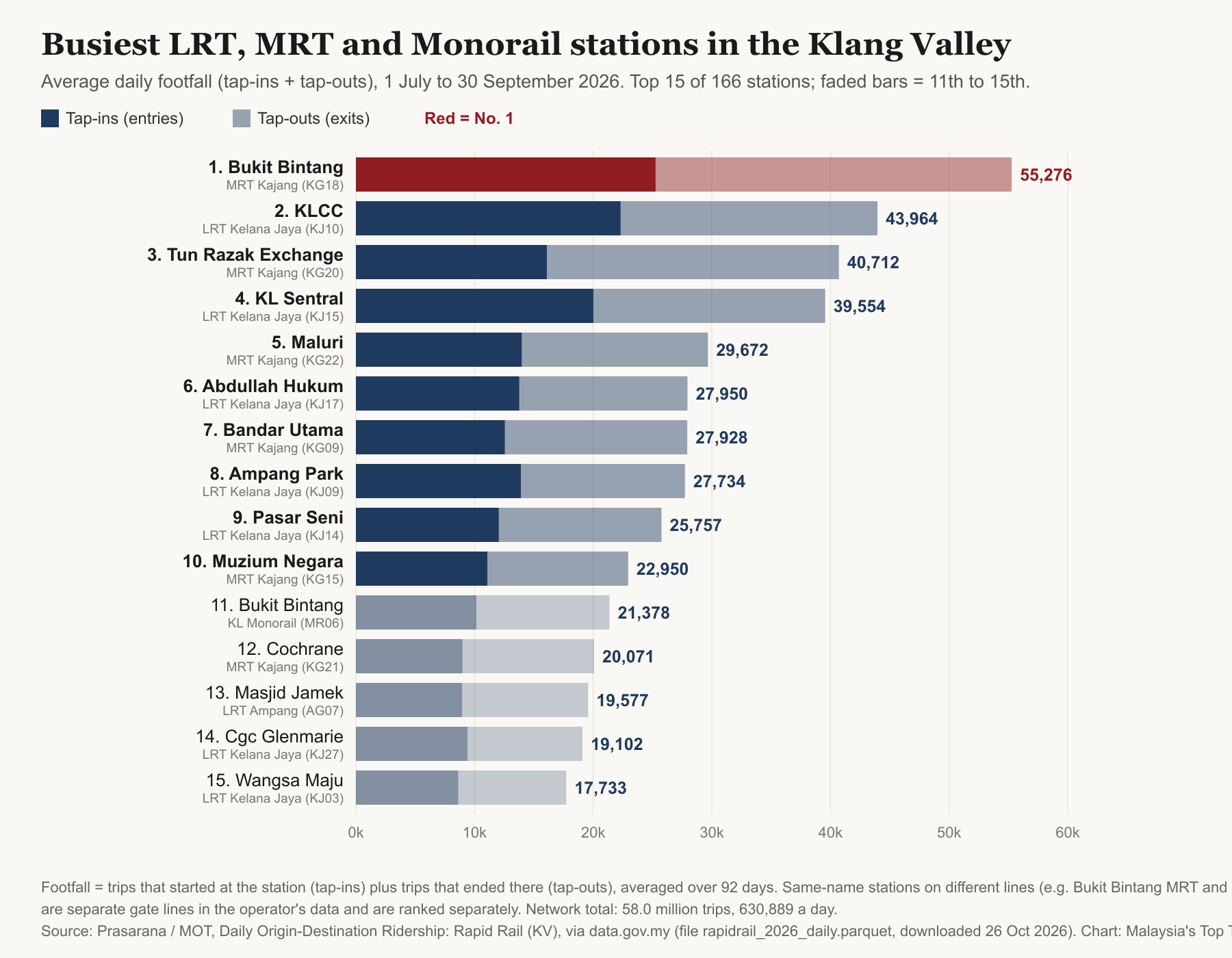
We counted every tap-in and tap-out at all 166 Rapid KL rail stations from 1 July to 30 September 2026, 58 million trips in total, using the operator's raw origin-destination data on data.gov.my. Bukit Bintang MRT is the busiest station in the Klang Valley at 55,276 passengers a day, ahead of KLCC LRT, Tun Razak Exchange and KL Sentral LRT, and the new LRT3 interchange has pushed Bandar Utama into the top ten.
This is a Data ranking. Positions come from one metric, average daily tap-ins plus tap-outs recorded at station gates between 1 July and 30 September 2026, computed by us from Prasarana's raw origin-destination file on data.gov.my. The data counts trips, not people, so a commuter who travels twice a day counts twice, and passengers changing lines inside a shared paid area are not counted at the interchange. We did not survey stations in person; facilities and surroundings are described from published sources.

Quick answer
Bukit Bintang MRT station on the Kajang Line is the busiest rail station in the Klang Valley in 2026, with an average of 55,276 passengers tapping in or out every day between 1 July and 30 September 2026, according to Malaysia's Top Ten's analysis of Prasarana's origin-destination ridership data published on data.gov.my. KLCC LRT (43,964 a day), Tun Razak Exchange MRT (40,712), KL Sentral LRT (39,554) and Maluri MRT (29,672) complete the top five. Across the whole Rapid KL rail network, 630,889 trips were made on an average day in the quarter, 5.0% more than in the same three months of 2025.
- Bukit Bintang MRT handles 55,276 passengers a day, 11,312 more than second-placed KLCC LRT. Add the separate Bukit Bintang Monorail station (21,378) and the Bukit Bintang precinct sees 76,654 rail passengers a day.
- Bandar Utama MRT is the fastest riser: footfall jumped from 19,345 a day in June 2026 to 30,340 in July after the LRT3 Shah Alam Line opened on 29 June 2026 with Bandar Utama as its interchange terminus, and the quarter is up 46.3% on July to September 2025.
- The single busiest station-to-station flow in the network is KLCC to Ampang Park, 224,492 trips in 92 days between two stations one stop apart, because Putrajaya Line passengers must exit at Ampang Park and re-enter the LRT to reach KLCC.
- Pasar Seni LRT is the only top-10 station busier on weekends (31,876 a day) than on weekdays (23,346); Abdullah Hukum, Ampang Park and Muzium Negara lose more than half their traffic at weekends.
- The network's busiest day of the quarter was Friday 7 August 2026 with 763,266 trips; Bukit Bintang, KLCC and Pasar Seni all set their quarterly highs on Sunday 30 August 2026, the eve of National Day.
How this ranking was decided
This is a Data ranking of all 166 LRT, MRT and KL Monorail stations operated by Rapid Rail in the Klang Valley. We downloaded Prasarana's daily origin-destination ridership file for 2026 from data.gov.my on 26 October 2026 (5.15 million rows of gate tap-in and tap-out counts), kept 1 July to 30 September 2026 (92 days, 58,041,775 trips) and ranked stations by average daily footfall: trips starting at the station plus trips ending there, divided by 92. Each station code in the operator's data is one entry, so same-name stations on different lines with their own gates (Bukit Bintang MRT and Monorail, Pasar Seni LRT and MRT) are ranked separately and their combined totals are given in the text. The window, metric and tie rule (more tap-ins wins) were fixed before any number was computed. KTM Komuter, ETS and the KLIA rail links are run by other operators and are not in the dataset.
Full details in How this ranking was produced below.
The ranking at a glance
| # | Name | Daily footfall (Jul–Sep 2026) | Best for | Main advantage | Main limitation |
|---|---|---|---|---|---|
| 1 | Bukit Bintang MRT (Kajang Line, KG18) | 55,276 (25,263 in / 30,013 out) | Shoppers and visitors heading to Pavilion, Lot 10, Fahrenheit88 and Jalan Alor, and Cheras residents commuting into the Golden Triangle. | Busiest station in the network, with weekend traffic almost equal to weekdays | No paid-area link to Bukit Bintang Monorail; the transfer is a street-level walk |
| 2 | KLCC LRT (Kelana Jaya Line, KJ10) | 43,964 (22,314 in / 21,651 out) | Visitors to the Twin Towers, Suria KLCC, Aquaria and the convention centre, and office workers across the KLCC district. | Busiest LRT station, with direct underground access to Suria KLCC | Down 3.9% year on year; weekends 27% quieter than weekdays |
| 3 | Tun Razak Exchange MRT (Kajang & Putrajaya lines, KG20) | 40,712 (16,095 in / 24,617 out) | Office workers in TRX, shoppers at The Exchange TRX and anyone switching between the Kajang and Putrajaya lines. | Growing 3.8% year on year; the only MRT-to-MRT interchange inside one paid area | Line-to-line transfers are invisible in the gate data, so true crowding is understated |
| 4 | KL Sentral LRT (Kelana Jaya Line, KJ15) | 39,554 (20,016 in / 19,538 out) | Travellers connecting to KLIA trains, KTM and ETS services, and commuters from Brickfields and Bangsar. | Malaysia's main rail hub; LRT and Monorail gates together handle 52,692 a day | Footfall down 5.6% year on year, the largest fall in the top ten |
| 5 | Maluri MRT (Kajang Line, KG22) | 29,672 (13,987 in / 15,685 out) | Cheras residents commuting to Bukit Bintang and TRX, and shoppers at Sunway Velocity and AEON Maluri. | Growing 3.3% year on year; paid-area interchange with the Ampang Line | Transfers from the Ampang Line do not register at its gates, so platform use is understated |
| 6 | Abdullah Hukum LRT (Kelana Jaya Line, KJ17) | 27,950 (13,774 in / 14,177 out) | Office workers in KL Eco City and Mid Valley City, and shoppers who prefer the LRT to the KTM Mid Valley station. | Direct covered bridge to Mid Valley Megamall, The Gardens and KL Eco City | Weekend traffic less than half the weekday level |
| 7 | Bandar Utama MRT (Kajang Line, KG09) | 27,928 (12,560 in / 15,368 out) | Shah Alam and Klang commuters transferring from LRT3 to the MRT, and 1 Utama shoppers. | Fastest-growing top-10 station, up 46.3% year on year after the LRT3 opening | Part of the July surge came from six weeks of free LRT3 travel |
| 8 | Ampang Park LRT (Kelana Jaya Line, KJ09) | 27,734 (13,905 in / 13,829 out) | Putrajaya Line passengers heading to KLCC, and office workers along Jalan Ampang and at The Intermark. | Interchange effect: about 2,440 trips a day to KLCC alone | Out-of-station transfer with a street-level walk between the two lines; weekends 55% quieter |
| 9 | Pasar Seni LRT (Kelana Jaya Line, KJ14) | 25,757 (12,047 in / 13,710 out) | Tourists visiting Chinatown, Central Market and Merdeka Square, and weekend day-trippers. | Weekend footfall of 31,876 a day, the only top-10 station busier at weekends | Prone to congestion and entry controls at peaks; down 5.5% year on year |
| 10 | Muzium Negara MRT (Kajang Line, KG15) | 22,950 (11,090 in / 11,860 out) | Kajang Line passengers connecting to KL Sentral, and visitors to the National Museum and the Islamic Arts Museum. | Growing 2.6% year on year; covered walkway into KL Sentral | Weekend traffic halves |
Ask a Kuala Lumpur commuter which train station is the busiest and most will say KL Sentral. The gate data says otherwise. Prasarana now publishes a daily count of every journey between every pair of stations on the Rapid KL network, built from anonymous tap-in and tap-out transactions (data.gov.my). We took the 2026 file, kept the three complete months from July to September, and added up, for each of the 166 LRT, MRT and Monorail stations, how many trips began there and how many ended there. Over those 92 days the network recorded 58,041,775 trips, or 630,889 a day, up 5.0% on the same months of 2025.
The result is a map of where the Klang Valley actually goes. The top of the table belongs to shopping and office districts in the city centre, led by Bukit Bintang MRT at 55,276 passengers a day, not to the suburban terminals where the morning crush begins. Two stations owe their place to interchanges, one of them new: Bandar Utama MRT gained 11,000 daily passengers the month the LRT3 Shah Alam Line opened. For how we build Data rankings, see our ranking methodology; for more on getting around and staying in the capital, browse the Travel & Hotels hub.
How we counted
| Rule | What we did |
|---|---|
| Metric | Average daily footfall = trips that started at the station (tap-ins) + trips that ended there (tap-outs), divided by 92 days. |
| Window | 1 July to 30 September 2026, the three latest complete calendar months in the file (which runs to 24 October 2026). |
| Station | One entry per station code in the operator's data. Where two lines have separate gates under the same name (Bukit Bintang MRT and Monorail, Pasar Seni LRT and MRT, Maluri, Masjid Jamek, Ampang Park, KL Sentral LRT and Monorail), each is ranked on its own and the combined figure is reported. Tun Razak Exchange has one code because the Kajang and Putrajaya lines share its paid area. |
| Excluded | The aggregate row labelled All Stations; KTM Komuter, ETS, KLIA Ekspres and Transit (other operators, not in the dataset); the BRT Sunway Line (separate bus dataset). |
| Tie rule | More tap-ins ranks higher. Not needed. |
Shopping streets beat office towers
Bukit Bintang MRT is first by a wide margin, and the pattern of its traffic explains why. On weekdays it averages 55,746 passengers; on weekends 54,082. No other station in the top ten holds up like that at the weekend, which points to shoppers and visitors to Pavilion Kuala Lumpur, Lot 10 and Jalan Alor rather than office workers. The station opened on 17 July 2017 with entrances built into the surrounding malls under MRT Corp's naming-rights scheme (Malay Mail). Its heaviest flows run east along the Cheras corridor, to Maluri (188,277 trips in the quarter), Tun Razak Exchange (175,907) and Cochrane (126,729). The Monorail station of the same name, a street-level walk away, adds another 21,378 a day, so the precinct as a whole sees 76,654 rail passengers daily. Where those shoppers are heading is covered in our ranking of Kuala Lumpur's top shopping malls.
KLCC LRT (43,964) and Tun Razak Exchange MRT (40,712) are the two financial-district stations. KLCC is the busiest LRT station in the country and still the weekday workhorse: 47,597 on weekdays against 34,743 at weekends. TRX is the only station in the top four that is growing, up 3.8% on a year earlier, as the district fills out. By May 2025 the MRT station was reported to be handling about 50,000 people a day, and TRX City puts the district at roughly 120 companies, close to 20,000 knowledge workers and about 400 retail and food brands in The Exchange TRX mall (EdgeProp). TRX also records far more exits (24,617 a day) than entries (16,095): people ride in and leave another way.
The interchange effect
Bandar Utama MRT, beside 1 Utama, averaged 19,345 passengers a day in June 2026. In July it averaged 30,340. The difference is the LRT3 Shah Alam Line, which opened on 29 June 2026 with Bandar Utama as its northern terminus and carried 60,000 passenger trips on its first day (New Straits Times). Rides were free until 14 August (Malay Mail), and Bandar Utama MRT eased to 27,214 in August and 26,173 in September once fares began, still 35% above June. The LRT3 station next door has its own gates and recorded a further 7,585 a day. The same line produced the biggest percentage jump anywhere in the network: CGC Glenmarie on the Kelana Jaya Line, the other LRT3 interchange, more than doubled from 8,915 to 19,102 a day and now sits 14th.
Older interchanges shape the table too. The busiest single flow in the entire network is from KLCC to Ampang Park, 224,492 trips in the quarter, with 194,657 the other way. The two stations are one stop apart. The reason is that the Putrajaya Line's Ampang Park station, opened in March 2023 (New Straits Times), is not inside the LRT's paid area, so anyone coming from Kepong, Sri Damansara or Putrajaya to the Twin Towers taps out, walks across and taps in again for a one-stop ride. That out-of-station transfer is what lifts Ampang Park LRT to eighth. Maluri, where the Ampang Line and Kajang Line are linked inside the paid area, shows the opposite: transfers there are invisible at the gates, yet its own entrances still produce 29,672 a day, the fifth-highest figure, as the gateway from Cheras to Bukit Bintang (185,190 trips) and TRX. Abdullah Hukum (27,950) is a one-building interchange of a different kind: since the 250-metre pedestrian bridge across the Klang River opened in November 2019 it has been the LRT stop for Mid Valley Megamall, The Gardens and KL Eco City (New Straits Times), and it is the most office-dependent station in the ten, falling from 33,026 on weekdays to 15,067 at weekends.
Weekdays, weekends and the big days
Pasar Seni LRT, serving Central Market, Petaling Street and Merdeka Square, is the only station in the top ten that is busier at the weekend: 31,876 a day against 23,346 on weekdays. Its single busiest day of the quarter was Sunday 30 August 2026, the eve of National Day, when 54,333 passengers passed through, more than double its average; Bukit Bintang (79,240) and KLCC (79,039) also peaked that day. The station's crowds have become an operational issue. On 8 September 2026 Rapid KL confirmed congestion at Pasar Seni and imposed entry and passenger-flow controls (The Vibes), and on 8 October it was one of six Kelana Jaya Line stations under crowd control during the morning peak (New Straits Times). Travellers choosing where to stay can cross-check station traffic against our ranking of the highest-rated hotels in Kuala Lumpur.
For the network as a whole, the busiest day in the quarter was Friday 7 August 2026, with 763,266 trips, and the busiest day of 2026 so far was Friday 2 October, with 764,139. Both are ordinary working Fridays, well short of the all-time record of 1.29 million rail passengers on New Year's Eve 2025, when the Kajang Line alone carried 396,141 (The Star). By line, Prasarana's headline ridership series for July and August 2026 averages 275,773 boardings a day on the Kajang Line, 256,891 on Kelana Jaya, 203,187 on Ampang and Sri Petaling, 167,826 on Putrajaya, 58,572 on the Monorail and 51,134 on the new Shah Alam Line (data.gov.my); those line figures count each leg of a transfer journey, so they add to more than the gate total.
What the station rule changes
Ranking by station code is the only way to use the operator's data without guessing, but it matters for three names. KL Sentral LRT (39,554) and KL Sentral Monorail (13,138) have separate gates; together they would be second at 52,692, and adding Muzium Negara MRT (22,950), which is joined to KL Sentral by a covered walkway, gives 75,642, within a thousand of the Bukit Bintang precinct. The whole of Stesen Sentral is busier still, because KTM Komuter, ETS and the KLIA trains are not in this dataset. Pasar Seni LRT (25,757) and Pasar Seni MRT (14,471) would combine to 40,228, fifth place. Masjid Jamek is recorded under two codes, 19,577 on the Ampang Line side and 12,723 on the Kelana Jaya side; combined it would be ninth at 32,300 instead of thirteenth. Visitors to the capital's museums will find our ranking of Kuala Lumpur's museums useful alongside this one, and readers interested in how Malaysians move more generally can see our ranking of the best-selling car brands, built from the same open-data portal.
The full ranking
Bukit Bintang MRT (Kajang Line, KG18)
Underground Kajang Line station beneath Jalan Bukit Bintang, opened 17 July 2017, with entrances built into Pavilion Kuala Lumpur and the surrounding shopping strip. The KL Monorail station of the same name is a separate station a short street-level walk away.
Why it was selected
55,276 passengers a day between 1 July and 30 September 2026, 25,263 tapping in and 30,013 tapping out (Prasarana via data.gov.my), 11,312 clear of second place. It is the only top-10 station whose traffic barely changes at the weekend, 55,746 on weekdays against 54,082 on Saturdays and Sundays, which marks it as a shoppers' and visitors' station rather than an office one. Its largest flows run along the Cheras corridor to Maluri (188,277 trips in the quarter), Tun Razak Exchange (175,907) and Cochrane (126,729). Its busiest day was Sunday 30 August 2026, the eve of National Day, with 79,240 passengers. Footfall is 0.8% below the same quarter of 2025. Adding the Monorail station's 21,378 gives the precinct 76,654 rail passengers a day.
Best for
Shoppers and visitors heading to Pavilion, Lot 10, Fahrenheit88 and Jalan Alor, and Cheras residents commuting into the Golden Triangle.
Advantages
- Busiest station in the network, with weekend traffic almost equal to weekdays
Limitations
- No paid-area link to Bukit Bintang Monorail; the transfer is a street-level walk
- Location:
- Jalan Bukit Bintang, Kuala Lumpur
- Verified:
- 26 Oct 2026
- Daily footfall (Jul–Sep 2026):
- 55,276 (25,263 in / 30,013 out)
- Weekday / weekend:
- 55,746 / 54,082
- Change vs Jul–Sep 2025:
- -0.8%
Sources: Prasarana Rapid Rail origin-destination ridership — data.gov.my, Malay Mail — Bukit Bintang MRT and the Pavilion link (2017)
KLCC LRT (Kelana Jaya Line, KJ10)
Underground Kelana Jaya Line station beneath the KLCC precinct, with direct access to Suria KLCC, the Petronas Twin Towers, the Kuala Lumpur Convention Centre and KLCC Park.
Why it was selected
43,964 passengers a day (22,314 in, 21,651 out), the busiest LRT station in the country and second overall (Prasarana via data.gov.my). It is a weekday station first: 47,597 on working days, 34,743 at weekends. Its flow to Ampang Park, 224,492 trips in 92 days, is the single largest station-to-station movement in the network even though the two are one stop apart, the product of Putrajaya Line passengers transferring out of station at Ampang Park. KL Sentral (145,719) and Wangsa Maju (117,483) are the next largest destinations. Its busiest day was 30 August 2026, with 79,039 passengers, almost double its average. Footfall is down 3.9% on July to September 2025, when it averaged 45,737.
Best for
Visitors to the Twin Towers, Suria KLCC, Aquaria and the convention centre, and office workers across the KLCC district.
Advantages
- Busiest LRT station, with direct underground access to Suria KLCC
Limitations
- Down 3.9% year on year; weekends 27% quieter than weekdays
- Location:
- Jalan Ampang, Kuala Lumpur City Centre
- Verified:
- 26 Oct 2026
- Daily footfall (Jul–Sep 2026):
- 43,964 (22,314 in / 21,651 out)
- Weekday / weekend:
- 47,597 / 34,743
- Change vs Jul–Sep 2025:
- -3.9%
Sources: Prasarana Rapid Rail origin-destination ridership — data.gov.my
Tun Razak Exchange MRT (Kajang & Putrajaya lines, KG20)
Underground interchange where the Kajang and Putrajaya lines share one paid area beneath the Tun Razak Exchange financial district, with a direct link to The Exchange TRX mall and the Exchange 106 tower.
Why it was selected
40,712 passengers a day (16,095 in, 24,617 out) between July and September 2026 (Prasarana via data.gov.my), up 3.8% on the 39,217 of a year earlier and the only one of the top four that is growing. Far more people exit than enter, by about 8,500 a day. Because both lines share the paid area, passengers changing between them do not register at the gates, so platform use is higher than the count. The MRT station was reported to be handling about 50,000 people a day as of May 2025, serving a district of roughly 120 companies, close to 20,000 knowledge workers and about 400 retail and food brands in the mall (EdgeProp, May 2026). Its largest flows are to Bukit Bintang (194,415 trips), Maluri (120,812) and Cochrane (118,274); its busiest day was Malaysia Day, 16 September 2026, with 70,012 passengers.
Best for
Office workers in TRX, shoppers at The Exchange TRX and anyone switching between the Kajang and Putrajaya lines.
Advantages
- Growing 3.8% year on year; the only MRT-to-MRT interchange inside one paid area
Limitations
- Line-to-line transfers are invisible in the gate data, so true crowding is understated
- Location:
- Tun Razak Exchange, Kuala Lumpur
- Verified:
- 26 Oct 2026
- Daily footfall (Jul–Sep 2026):
- 40,712 (16,095 in / 24,617 out)
- Weekday / weekend:
- 42,863 / 35,251
- Change vs Jul–Sep 2025:
- +3.8%
Sources: Prasarana Rapid Rail origin-destination ridership — data.gov.my, EdgeProp — How TRX reshapes the appeal of KL CBD (May 2026)
KL Sentral LRT (Kelana Jaya Line, KJ15)
The Kelana Jaya Line platforms inside Stesen Sentral in Brickfields, the country's main rail hub, which also houses KTM Komuter, ETS, KLIA Ekspres and Transit and a separate KL Monorail station.
Why it was selected
39,554 passengers a day (20,016 in, 19,538 out) between July and September 2026 (Prasarana via data.gov.my), with a strong weekday skew of 43,859 against 28,627 at weekends. Its largest flows are to KLCC (157,168 trips), Bank Rakyat Bangsar (147,338) and Abdullah Hukum (131,269). It recorded the largest year-on-year fall in the top ten, down 5.6% from 41,913. The KL Sentral Monorail station has its own gates and adds 13,138 a day; combined, the two would be second at 52,692, and with Muzium Negara MRT (22,950), reached by a covered walkway, the complex reaches 75,642. KTM, ETS and KLIA rail passengers are not in Prasarana's data, so the building's total footfall is higher still. Its busiest day of the quarter was 31 July 2026, with 48,301 passengers.
Best for
Travellers connecting to KLIA trains, KTM and ETS services, and commuters from Brickfields and Bangsar.
Advantages
- Malaysia's main rail hub; LRT and Monorail gates together handle 52,692 a day
Limitations
- Footfall down 5.6% year on year, the largest fall in the top ten
- Location:
- Stesen Sentral, Brickfields, Kuala Lumpur
- Verified:
- 26 Oct 2026
- Daily footfall (Jul–Sep 2026):
- 39,554 (20,016 in / 19,538 out)
- Weekday / weekend:
- 43,859 / 28,627
- Change vs Jul–Sep 2025:
- -5.6%
Sources: Prasarana Rapid Rail origin-destination ridership — data.gov.my
Maluri MRT (Kajang Line, KG22)
Underground Kajang Line station in Cheras, linked inside the paid area to the elevated Maluri station on the Ampang Line, with Sunway Velocity Mall and AEON Taman Maluri at street level.
Why it was selected
29,672 passengers a day (13,987 in, 15,685 out) between July and September 2026, up 3.3% on a year earlier (Prasarana via data.gov.my). Weekdays average 31,390 and weekends 25,311. Maluri is the gateway from Cheras into the Golden Triangle: its flow to Bukit Bintang, 185,190 trips in the quarter, is the fifth-largest in the network, followed by Tun Razak Exchange (118,028) and Muzium Negara (62,037). Because the Ampang Line interchange is inside the paid area, LRT passengers changing here are counted at their original station, not at Maluri, and the Ampang Line's own Maluri gates add a further 7,066 a day. Its busiest day of the quarter was 31 July 2026, with 33,653 passengers.
Best for
Cheras residents commuting to Bukit Bintang and TRX, and shoppers at Sunway Velocity and AEON Maluri.
Advantages
- Growing 3.3% year on year; paid-area interchange with the Ampang Line
Limitations
- Transfers from the Ampang Line do not register at its gates, so platform use is understated
- Location:
- Jalan Cheras, Kuala Lumpur
- Verified:
- 26 Oct 2026
- Daily footfall (Jul–Sep 2026):
- 29,672 (13,987 in / 15,685 out)
- Weekday / weekend:
- 31,390 / 25,311
- Change vs Jul–Sep 2025:
- +3.3%
Sources: Prasarana Rapid Rail origin-destination ridership — data.gov.my
Abdullah Hukum LRT (Kelana Jaya Line, KJ17)
Elevated Kelana Jaya Line station between KL Sentral and Bangsar, linked since 14 November 2019 by a 250-metre pedestrian bridge over the Klang River to KL Eco City, Mid Valley Megamall and The Gardens Mall.
Why it was selected
27,950 passengers a day (13,774 in, 14,177 out) between July and September 2026, almost unchanged from a year earlier (Prasarana via data.gov.my). It is the most office-dependent station in the top ten: 33,026 on weekdays against 15,067 at weekends, a drop of 54%. Its largest flows are to KL Sentral (137,023 trips), Universiti (77,704) and Bank Rakyat Bangsar (59,999). The covered bridge that opened in November 2019, after years of delay, turned it into the LRT stop for Mid Valley City and the KL Eco City office towers (New Straits Times). Its busiest day of the quarter was Wednesday 12 August 2026, with 36,477 passengers.
Best for
Office workers in KL Eco City and Mid Valley City, and shoppers who prefer the LRT to the KTM Mid Valley station.
Advantages
- Direct covered bridge to Mid Valley Megamall, The Gardens and KL Eco City
Limitations
- Weekend traffic less than half the weekday level
- Location:
- Jalan Bangsar, Kuala Lumpur
- Verified:
- 26 Oct 2026
- Daily footfall (Jul–Sep 2026):
- 27,950 (13,774 in / 14,177 out)
- Weekday / weekend:
- 33,026 / 15,067
- Change vs Jul–Sep 2025:
- -0.3%
Sources: Prasarana Rapid Rail origin-destination ridership — data.gov.my, New Straits Times — Mid Valley pedestrian bridge opens (2019)
Bandar Utama MRT (Kajang Line, KG09)
Elevated Kajang Line station beside 1 Utama Shopping Centre in Petaling Jaya, and since 29 June 2026 the northern terminus and interchange of the LRT3 Shah Alam Line, whose station has its own gates next door.
Why it was selected
27,928 passengers a day (12,560 in, 15,368 out) between July and September 2026, 46.3% more than the 19,094 of a year earlier, the biggest rise in the top ten (Prasarana via data.gov.my). The cause is the LRT3 Shah Alam Line, which opened on 29 June 2026 and carried 60,000 trips on its first day (New Straits Times). Bandar Utama MRT averaged 19,345 a day in June, 30,340 in July, then 27,214 in August and 26,173 in September after free rides ended on 14 August (Malay Mail). Because the LRT3 station is a separate set of gates, each transfer counts as an exit here and an entry there; the LRT3 side recorded 7,585 a day. Its largest flows are to Mutiara Damansara (105,071 trips), Surian (97,184) and Bukit Bintang (86,426). Its busiest day was 31 July 2026, with 33,960 passengers.
Best for
Shah Alam and Klang commuters transferring from LRT3 to the MRT, and 1 Utama shoppers.
Advantages
- Fastest-growing top-10 station, up 46.3% year on year after the LRT3 opening
Limitations
- Part of the July surge came from six weeks of free LRT3 travel
- Location:
- Bandar Utama, Petaling Jaya, Selangor
- Verified:
- 26 Oct 2026
- Daily footfall (Jul–Sep 2026):
- 27,928 (12,560 in / 15,368 out)
- Weekday / weekend:
- 30,016 / 22,629
- Change vs Jul–Sep 2025:
- +46.3%
Sources: Prasarana Rapid Rail origin-destination ridership — data.gov.my, New Straits Times — 60,000 passenger trips on first day of LRT3 (June 2026), Malay Mail — LRT3 free rides extended until Aug 14 (July 2026)
Ampang Park LRT (Kelana Jaya Line, KJ09)
Underground Kelana Jaya Line station at the northern end of the KLCC district on Jalan Ampang. The Putrajaya Line's Ampang Park station, opened in March 2023, is a separate station reached by a covered walkway at street level.
Why it was selected
27,734 passengers a day (13,905 in, 13,829 out) between July and September 2026 (Prasarana via data.gov.my), 32,801 on weekdays and 14,874 at weekends. Its numbers are shaped by the out-of-station interchange with the Putrajaya Line, which opened its second phase in March 2023 (New Straits Times): passengers from Kepong, Sri Damansara and Putrajaya heading to the Twin Towers tap out of the MRT, walk across and tap into the LRT for a one-stop ride. That is why KLCC to Ampang Park (224,492 trips in the quarter) and Ampang Park to KLCC (194,657) are the two largest flows in the network, ahead of Wangsa Maju (189,556) and Taman Melati (84,808). The Putrajaya Line side recorded 5,511 a day at its own gates. Footfall is down 2.4% on a year earlier; its busiest day was 2 September 2026, with 36,067 passengers.
Best for
Putrajaya Line passengers heading to KLCC, and office workers along Jalan Ampang and at The Intermark.
Advantages
- Interchange effect: about 2,440 trips a day to KLCC alone
Limitations
- Out-of-station transfer with a street-level walk between the two lines; weekends 55% quieter
- Location:
- Jalan Ampang, Kuala Lumpur
- Verified:
- 26 Oct 2026
- Daily footfall (Jul–Sep 2026):
- 27,734 (13,905 in / 13,829 out)
- Weekday / weekend:
- 32,801 / 14,874
- Change vs Jul–Sep 2025:
- -2.4%
Sources: Prasarana Rapid Rail origin-destination ridership — data.gov.my, New Straits Times — Putrajaya MRT Line phase 2 operational March 2023
Pasar Seni LRT (Kelana Jaya Line, KJ14)
Elevated Kelana Jaya Line station beside Central Market, Petaling Street and Kasturi Walk, connected by pedestrian bridges to the separate Pasar Seni MRT station and to Kuala Lumpur KTM station.
Why it was selected
25,757 passengers a day (12,047 in, 13,710 out) between July and September 2026 (Prasarana via data.gov.my), and the only station in the top ten that is busier at weekends, 31,876, than on weekdays, 23,346. Its busiest day of the quarter was Sunday 30 August 2026, the eve of National Day, when 54,333 passengers passed through, more than double its average. Its largest flows are to Bukit Bintang (110,020 trips), KL Sentral (102,742) and KLCC (88,389). The crowds have become an operational issue: on 8 September 2026 Rapid KL confirmed congestion at Pasar Seni and imposed entry and passenger-flow controls (The Vibes), and on 8 October it was one of six Kelana Jaya Line stations under crowd control (New Straits Times). Footfall is down 5.5% on a year earlier. The MRT station next door adds 14,471 a day; combined, Pasar Seni would be fifth at 40,228.
Best for
Tourists visiting Chinatown, Central Market and Merdeka Square, and weekend day-trippers.
Advantages
- Weekend footfall of 31,876 a day, the only top-10 station busier at weekends
Limitations
- Prone to congestion and entry controls at peaks; down 5.5% year on year
- Location:
- Jalan Tun Tan Cheng Lock, Kuala Lumpur
- Verified:
- 26 Oct 2026
- Daily footfall (Jul–Sep 2026):
- 25,757 (12,047 in / 13,710 out)
- Weekday / weekend:
- 23,346 / 31,876
- Change vs Jul–Sep 2025:
- -5.5%
Sources: Prasarana Rapid Rail origin-destination ridership — data.gov.my, The Vibes — Pasar Seni crowds surge (September 2026), New Straits Times — Packed platforms on the Kelana Jaya line (October 2026)
Muzium Negara MRT (Kajang Line, KG15)
Underground Kajang Line station beside the National Museum, connected by a covered walkway to Stesen Sentral; in practice the MRT's KL Sentral stop.
Why it was selected
22,950 passengers a day (11,090 in, 11,860 out) between July and September 2026, up 2.6% on the 22,371 of a year earlier (Prasarana via data.gov.my). It is a commuter station: 26,632 on weekdays and 13,602 at weekends, a drop of 49%. Its largest flows run to Bukit Bintang (76,280 trips) and Maluri (64,841), and it is the main way Kajang Line passengers reach KL Sentral's KTM, ETS and KLIA trains. Taken with KL Sentral's LRT and Monorail gates, the Sentral complex handles 75,642 Rapid KL passengers a day, within a thousand of the Bukit Bintang precinct. Its busiest day of the quarter was 5 August 2026, with 28,638 passengers.
Best for
Kajang Line passengers connecting to KL Sentral, and visitors to the National Museum and the Islamic Arts Museum.
Advantages
- Growing 2.6% year on year; covered walkway into KL Sentral
Limitations
- Weekend traffic halves
- Location:
- Jalan Damansara, Kuala Lumpur
- Verified:
- 26 Oct 2026
- Daily footfall (Jul–Sep 2026):
- 22,950 (11,090 in / 11,860 out)
- Weekday / weekend:
- 26,632 / 13,602
- Change vs Jul–Sep 2025:
- +2.6%
Sources: Prasarana Rapid Rail origin-destination ridership — data.gov.my
Frequently asked questions
Which is the busiest LRT or MRT station in Kuala Lumpur in 2026?
Bukit Bintang MRT station on the Kajang Line is the busiest rail station in Kuala Lumpur and the Klang Valley in 2026, with an average of 55,276 passengers tapping in or out each day between 1 July and 30 September 2026, according to Malaysia's Top Ten's analysis of Prasarana's origin-destination data on data.gov.my. It is followed by KLCC LRT (43,964 a day), Tun Razak Exchange MRT (40,712), KL Sentral LRT (39,554) and Maluri MRT (29,672). Counting the separate Bukit Bintang Monorail station as well, the Bukit Bintang precinct handles 76,654 rail passengers a day.
Which is the busiest LRT station in the Klang Valley?
KLCC on the Kelana Jaya Line is the busiest LRT station in the Klang Valley, with 43,964 passengers a day (22,314 tap-ins and 21,651 tap-outs) between July and September 2026, according to Malaysia's Top Ten's count from Prasarana data. The next busiest LRT stations are KL Sentral (39,554), Abdullah Hukum (27,950), Ampang Park (27,734) and Pasar Seni (25,757), all on the Kelana Jaya Line. The busiest Ampang Line station is Masjid Jamek at 19,577, and the busiest station on the new Shah Alam Line (LRT3) is its Bandar Utama terminus at 7,585.
Which is the busiest MRT station in Malaysia?
Bukit Bintang on the Kajang Line is the busiest MRT station in Malaysia, with 55,276 passengers a day from July to September 2026, according to Malaysia's Top Ten's analysis of Prasarana's gate data. Tun Razak Exchange (40,712), the interchange shared by the Kajang and Putrajaya lines, is second, followed by Maluri (29,672), Bandar Utama (27,928) and Muzium Negara (22,950). All five are on or shared with the Kajang Line, which is also the busiest line in Prasarana's own ridership series at about 275,773 boardings a day in July and August 2026.
Is KL Sentral the busiest train station in Kuala Lumpur?
Not on Rapid KL gate counts alone. KL Sentral's LRT station handled 39,554 passengers a day between July and September 2026, fourth in the Klang Valley behind Bukit Bintang MRT, KLCC LRT and Tun Razak Exchange, according to Malaysia's Top Ten's analysis of Prasarana data. Add the KL Sentral Monorail station (13,138) and the figure is 52,692; add Muzium Negara MRT (22,950), joined to KL Sentral by a walkway, and it is 75,642, close to the Bukit Bintang precinct's 76,654. KTM Komuter, ETS and KLIA Ekspres passengers are not in Prasarana's data, so the Stesen Sentral complex as a whole is almost certainly the busiest building, but the busiest single set of gates is Bukit Bintang MRT.
How many people use the LRT and MRT in Kuala Lumpur every day in 2026?
Rapid KL's rail network in the Klang Valley (LRT, MRT and Monorail) recorded 58,041,775 trips between 1 July and 30 September 2026, or 630,889 trips a day, according to Malaysia's Top Ten's count from Prasarana's origin-destination data on data.gov.my. That is 5.0% more than the 601,129 a day recorded in the same three months of 2025. The busiest day of the quarter was Friday 7 August 2026 with 763,266 trips, and the busiest day of 2026 to date was Friday 2 October with 764,139. The all-time record remains New Year's Eve 2025, when rail services carried 1.29 million passengers.
Which KL train station is busiest at the weekend?
Bukit Bintang MRT is the busiest station at weekends, averaging 54,082 passengers a day on Saturdays and Sundays between July and September 2026, barely below its weekday average of 55,746, according to Malaysia's Top Ten's analysis. Pasar Seni LRT, which serves Central Market, Petaling Street and Merdeka Square, is the only top-10 station that is busier at weekends (31,876) than on weekdays (23,346). KLCC averages 34,743 at weekends. The biggest weekend drops are at Abdullah Hukum (15,067, down 54% from weekdays), Ampang Park (14,874) and Muzium Negara (13,602).
How has the LRT3 Shah Alam Line changed station traffic in 2026?
The LRT3 Shah Alam Line, which opened on 29 June 2026 between Johan Setia and Bandar Utama, lifted its two interchange stations sharply, according to Malaysia's Top Ten's analysis of Prasarana data. Bandar Utama MRT went from 19,345 passengers a day in June 2026 to 30,340 in July, settling at 26,173 in September after free rides ended on 14 August, and its July to September average of 27,928 is 46.3% higher than a year earlier. CGC Glenmarie on the Kelana Jaya Line, the other interchange, more than doubled from 8,915 to 19,102 a day. The LRT3 line itself averaged 51,134 boardings a day in July and August 2026 in Prasarana's headline series.
How this ranking was produced
- Question: Which LRT, MRT and Monorail stations in the Klang Valley handle the most passengers?
- Type: Data ranking, one metric, no editorial adjustment. Window, metric, station definition and tie rule recorded on 26 October 2026 before any figure was computed.
- Source: Prasarana Malaysia / Ministry of Transport, Daily Origin-Destination Ridership: Rapid Rail (KV) (dataset
ridership_od_rapidrail_daily), filerapidrail_2026_daily.parquet, 5,154,138 rows covering 1 January to 24 October 2026, downloaded from storage.data.gov.my on 26 October 2026. Each row is the number of trips from one origin station to one destination station on one day, built from anonymous tap-in and tap-out transactions at the gates. The 2025 file (rapidrail_2025_daily.parquet) was used for the year-on-year comparison. - Window: 1 July to 30 September 2026, 92 days, 58,041,775 trips. The three latest complete calendar months; October 2026 was incomplete and not used.
- Metric: average daily footfall = (sum of trips with the station as origin + sum of trips with the station as destination) ÷ 92. Weekday and weekend averages, monthly averages, top destinations and busiest days were computed the same way for context.
- Station definition: one entry per station code as recorded by the operator (166 codes). Same-name stations on different lines with their own gates are separate entries; combined totals are reported in the text but do not change the order. Tun Razak Exchange appears under a single code because both MRT lines share its paid area.
- Exclusions: rows with origin or destination labelled All Stations (an aggregate; we verified it equals the sum of the real origins for the same day and destination); KTM, ERL and BRT services, which are not in the dataset.
- Same-station trips: trips recorded with the same origin and destination (2.96% of all trips) were kept as recorded and count once as a tap-in and once as a tap-out.
- Tie rule: higher tap-in count ranks higher. Not needed.
- Context data: Prasarana headline ridership by line (dataset
ridership_headline, to 31 August 2026) and the news reports listed under sources. No station was visited for this ranking.
Notable exclusions
Candidates considered but not ranked, and why:
- Bukit Bintang Monorail (MR06), 21,378 a day, 11th — A separate station with its own gates a short walk from the MRT station, so it is ranked on its own. Its weekend traffic (23,496) exceeds its weekday traffic (20,544). Combined with Bukit Bintang MRT the precinct handles 76,654 passengers a day.
- Cochrane MRT (KG21), 20,071 a day, 12th — The Kajang Line station for IKEA Cheras and MyTOWN, 2,879 passengers a day short of Muzium Negara. Like Bukit Bintang it is busier at weekends (21,030) than on weekdays (19,693).
- Masjid Jamek (AG07 19,577, 13th; KJ13 12,723) — Recorded under two station codes, one for the Ampang Line gates and one for the Kelana Jaya Line gates. Combined footfall of 32,300 would place it ninth; under the one-code-per-entry rule declared before counting, neither code reaches the top ten.
- CGC Glenmarie LRT (KJ27), 19,102 a day, 14th — The biggest percentage gain in the network, from 8,915 a day in July to September 2025, after it became the Kelana Jaya Line interchange for the LRT3 Shah Alam Line on 29 June 2026. Still 3,848 short of tenth place.
- Wangsa Maju LRT (KJ03), 17,733 a day, 15th — The busiest suburban residential station in the network and the destination of 189,556 trips from Ampang Park in the quarter, but 5,217 a day below the top-ten cut-off.
- KL Sentral KTM, ETS and KLIA Ekspres, Mid Valley and other KTM Komuter stations — Operated by KTMB and Express Rail Link, not Prasarana, so they are not in the Rapid Rail origin-destination dataset. KTMB publishes its own hourly origin-destination files on data.gov.my, which we will use for a separate ranking of KTM ETS and intercity routes.
- BRT Sunway Line stops — Published as a separate bus dataset (ridership_od_brt_daily) and not part of the rail network counted here.
Sources & references
- data.gov.my — Daily Origin-Destination Ridership: Rapid Rail (KV) (ridership_od_rapidrail_daily), Prasarana / MOT
- Raw file — rapidrail_2026_daily.parquet (downloaded 26 October 2026)
- Raw file — rapidrail_2025_daily.parquet (year-on-year comparison)
- data.gov.my — Daily Public Transport Ridership by line (ridership_headline), Prasarana / MOT
- The Star — New Year ridership hits record high for Prasarana (3 January 2026)
- New Straits Times — 60,000 passenger trips on first day of LRT3 (30 June 2026)
- Malay Mail — Rapid KL extends free rides on LRT3 Shah Alam Line until Aug 14 (31 July 2026)
- EdgeProp — Changing the game: how TRX reshapes the appeal of KL CBD (20 May 2026)
- The Vibes — Kelana Jaya LRT commuters face delays as Pasar Seni crowds surge (8 September 2026)
- New Straits Times — Packed platforms, long waits hit Kelana Jaya LRT line (8 October 2026)
- New Straits Times — Mid Valley reachable by LRT thanks to new pedestrian bridge (November 2019)
- Malay Mail — The MRT station that is a hopscotch away from shops (30 October 2017)
- New Straits Times — Phase 2 of Putrajaya MRT Line operational March 2023 (December 2022)
Limitations
The dataset counts trips recorded at the gates, not individual people, so a commuter making a return journey counts twice and anyone who taps in and out at the same station is counted as a trip. Passengers who change lines inside a shared paid area (Tun Razak Exchange, Maluri, Pasar Seni MRT to LRT via the paid link) do not register at the interchange, while out-of-station transfers (Ampang Park, Bandar Utama to LRT3, Bukit Bintang MRT to Monorail) register as an exit and a new entry, so interchange stations of the two kinds are not directly comparable. The one-code-per-entry rule is our editorial definition; combining same-name stations would move KL Sentral, Pasar Seni and Masjid Jamek up the table, as stated in the text. The file covers only Rapid Rail services, so KTM, ERL and BRT passengers are absent and the true footfall of multi-operator hubs such as KL Sentral is higher. July to September 2026 includes six weeks of free LRT3 travel, which flatters Bandar Utama and CGC Glenmarie relative to a fare-paying quarter. Figures are rounded to the nearest passenger per day from 92-day totals. Station facilities and surroundings are described from published sources, not site visits.
Update history
| Date | Update |
|---|---|
| 26 Oct 2026 | First published (Prasarana / MOT Rapid Rail origin-destination data for 1 July to 30 September 2026, downloaded from data.gov.my and computed on 26 October 2026). |
Spotted an error? Request a correction.
Related rankings

Selangor's 10 Largest MOTAC-Registered Homestay Clusters (2026)
Selangor's MOTAC-registered homestay clusters ranked by registered-operator count. Homestay Banghuris in Sepang leads at 40 operators, well ahead of Homestay Air Manis in Sabak Bernam.

Sabah's 10 Tallest Waterfalls (2026)
Sabah's waterfalls ranked by height, each inside a gazetted forest reserve, park or conservation area. Kadamaian Falls leads at an estimated 700 metres, nearly six times 2nd-placed Langanan Waterfall.

Best 10 MOTAC 5-Star Rated Hotels in Selangor (2026)
Sama-Sama Hotel holds the longest-remaining MOTAC 5-star certification among Selangor's rated hotels in 2026, valid until January 2029 — 29 months out from this research's 31 August 2026 capture — ahead of DoubleTree by Hilton Shah Alam i-City at 28 months and Sheraton Petaling Jaya Hotel at 27. MOTAC's official hotel-rating registry does not publish room counts for any property, so this list orders Selangor's 10 currently 5-star-rated hotels by certification validity remaining instead — a disclosed secondary signal, not a quality score. Nine of these 10 hotels cluster in Petaling Jaya, Shah Alam's i-City district, or the Sepang/KLIA area; Klang is the only other district represented.